
Description
Symptoms
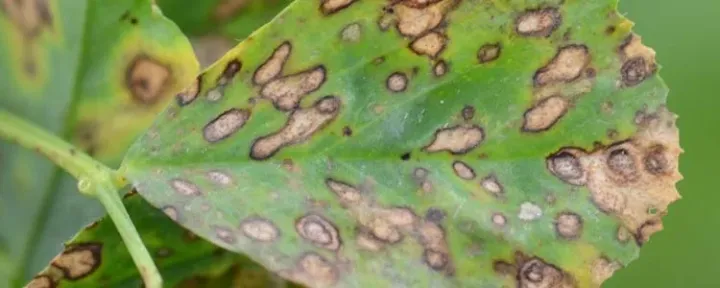
The first symptoms of the disease are small spots on the leaves, which are circular or irregular in shape. The color of the affected areas varies from pale yellow to brown, often surrounded by a dark border.
In the center of older spots, microscopic black dots form, which are the fruiting bodies of the fungus (perithecia). Under severe infestation, the leaves may turn yellow and wither prematurely.
On stems and petioles, the disease appears as elongated necrotic lesions. Under high humidity, these spots may merge, covering a significant portion of the leaf surface area.
Diagnosing the disease can be difficult because symptoms often mimic other types of leaf spots. Laboratory analysis is usually required for a definitive identification.
In soybean crops, the pathogen can also infect pods, causing deformation and reducing seed quality. This negatively impacts the overall photosynthetic capacity of the plants.
Pathogen
The causative agent of the disease is the ascomycete fungus Leptosphaerulina trifolii. It belongs to the class Dothideomycetes and is a facultative parasite that survives on plant debris.
The fungus produces perithecia containing ascospores, which serve as the primary source of infection for agricultural crops at the beginning of the growing season.
The pathogen is capable of surviving for long periods in the soil and on crop residues. Its high adaptability allows the fungus to thrive in various climatic conditions.
Spread during the growing season occurs via conidia and ascospores dispersed by wind and rain splashes. The incubation period is relatively short under favorable conditions.
The fungus displays significant genetic diversity, which complicates the selection of fungicides for effective suppression. Research into different strains is ongoing.
Conditions for development
The development of Leptosphaerulina leaf spot is highly dependent on humidity levels. Periods with frequent rainfall and high relative humidity are most conducive to the disease.
The optimal temperature for fungal growth and spore germination ranges from +20°C to +28°C. Rapid temperature fluctuations can also weaken plants, making them more susceptible.
Dense canopies, where air circulation is restricted, create a microclimate with excess humidity. This provides ideal conditions for the rapid spread of the fungus in soybean fields.
Failure to rotate crops and the presence of infected residue on the soil surface significantly increase the infection pressure. Certain weeds can also act as reservoirs for the pathogen.
Imbalanced mineral nutrition or excessive nitrogen application can increase susceptibility to the disease. Well-nourished plants generally show a stronger immune response.
Why it matters
The harm caused by the disease includes a reduction in the functional leaf area. This leads to a significant decrease in growth rates, plant development, and overall yield.
Early-stage infection often leads to mass leaf drop, which critically reduces crop productivity. Seed quality also deteriorates, which is unacceptable for commercial production.
In soybean fields, the pathogen can cause stem brittleness and premature pod ripening. This results in significant harvesting losses when using mechanized equipment.
Infected seeds can carry the pathogen, spreading the disease to subsequent seasons. This creates a cycle that makes it difficult to produce healthy seeds in future years.
Economic damage also includes the costs of fungicide applications. Failure to manage the disease can result in epiphytotics during seasons with abnormally high rainfall.
Protection
The primary control measure is crop rotation, ensuring that legumes are not planted in the same field for at least three to four years to break the pathogen's life cycle.
Properly incorporating plant debris into the soil is essential to accelerate its decomposition and destroy fungal structures. Deep plowing is a key preventive practice.
The use of fungicides during the active growing phase helps limit the spread of the leaf spot. It is recommended to rotate products with different modes of action to prevent resistance.
Weed control is mandatory, as many weed species act as hosts for Leptosphaerulina trifolii. Managing weeds also improves air circulation within the canopy.
- Use high-quality treated seeds for planting.
- Maintain optimal plant spacing to reduce canopy density.
- Select resistant soybean varieties and hybrids.
- Monitor fields regularly, especially during the flowering and pod-filling stages.
Pathogens and affected parts
Affects crops · 1
Discussion
No discussions yet — be the first.