
Description
Symptoms
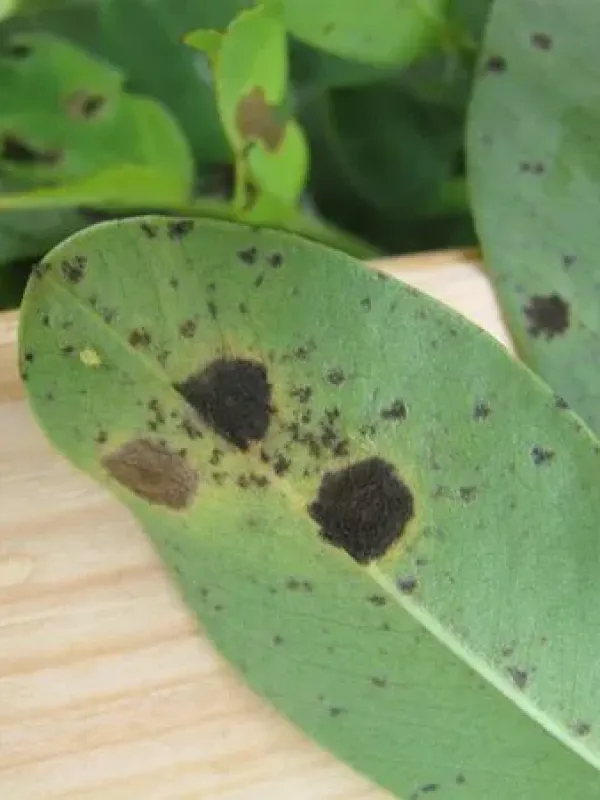
The characteristic symptoms of late leaf spot appear as small, circular lesions on the underside of peanut leaves. Unlike early leaf spot, these lesions are distinctively dark brown to black, often surrounded by a noticeable yellow halo that indicates tissue decline.
Under conditions of high relative humidity, the underside of the spots develops velvety, dark-colored spore masses. These are the reproductive structures of the fungus, which often leads to heavy defoliation of the crop starting from the lower canopy.
The infection is not limited to leaves; it also affects stems and petioles. On these parts, the fungus causes elongated, dark lesions that disrupt the plant's vascular system, hindering the transport of water and nutrients to the developing pods.
Severe infestations cause the entire canopy to appear scorched and withered. In extreme cases, the plant may lose all its leaves, leaving the stems exposed and significantly reducing the plant's ability to photosynthesize and accumulate biomass.
Distinguishing late leaf spot from early leaf spot is essential for proper chemical management. While both diseases are common, the darker, velvety appearance of the spores on the lower leaf surface is a key diagnostic feature for the Phaeoisariopsis pathogen.
Pathogen
The pathogen responsible for late leaf spot is the fungus Phaeoisariopsis personata, formerly and sometimes still referred to as Pseudocercospora personata. It is a highly specialized fungal parasite that primarily affects the peanut crop.
The fungus produces conidia, which act as the primary inoculums for spreading the disease. These spores are easily disseminated by wind, rain splashes, and human activity within the field, leading to rapid disease development during the growing season.
Phaeoisariopsis personata persists through the winter by surviving in crop debris left on the soil surface. This reservoir of inoculum is the primary source of infection for the subsequent crop if fields are not properly managed after harvest.
The lifecycle involves direct penetration of the host tissue or entry through the stomata. Once inside, the fungus develops an extensive mycelial network that colonizes the leaf tissue, eventually erupting through the surface to produce new spores.
High spore production rates throughout the season ensure that the disease can quickly reach epidemic levels if environmental conditions are favorable, making it one of the most economically damaging foliar diseases in peanut production globally.
Conditions for development
Late leaf spot thrives in environments characterized by high humidity levels, typically above 80%. Frequent rainfall and prolonged dew periods provide the essential moisture required for spore germination and colonization of the peanut foliage.
Temperature plays a crucial role in the development of the pathogen, with the fungus showing optimal growth between 20°C and 28°C. Deviations outside this range slow down the infection cycle, but do not necessarily eliminate the pathogen.
Densely planted fields, which impede air circulation, are highly susceptible to disease outbreaks. Poor airflow ensures that leaves remain wet for longer periods after rainfall, creating the perfect microclimate for the fungus to thrive.
Continuous cropping of peanuts on the same land facilitates the buildup of the pathogen in the soil. This leads to higher initial infection rates in following seasons, necessitating more intensive management efforts from the start.
Nutritional stress, particularly potassium deficiency, makes plants more vulnerable to fungal attacks. A well-nourished plant is more capable of sustaining its physiological functions even when exposed to a certain degree of pathogen pressure.
Why it matters
The primary economic impact of late leaf spot is the severe reduction in photosynthetic area due to premature defoliation. This loss of leaves significantly decreases the plant's capacity to fill pods, leading to lower yields and reduced quality.
Infected plants often produce shriveled or poorly developed seeds, which have lower market value and poor germination potential if saved as seeds. This creates long-term issues for farmers who rely on farm-saved seed for future planting.
Late leaf spot weakens the structural integrity of the pegs (the stems carrying the pods). This brittleness leads to substantial harvest losses, as many pods detach from the plant and remain in the soil during mechanical harvesting.
Increased susceptibility to other soil-borne diseases often follows a severe leaf spot outbreak, as the plant's overall defense mechanisms are compromised. This cumulative damage requires complex protection strategies, increasing farming costs.
Overall, late leaf spot can lead to yield losses of up to 50% if left unmanaged during high-pressure seasons. The combination of reduced quantity and poor seed quality represents a major challenge for profitable peanut farming.
Protection
The foundation of effective control is a rigorous crop rotation program, ideally with at least a 3-year break between peanut crops. This practice allows the inoculum in the soil to naturally decline, reducing the disease pressure for future plantings.
Deep plowing or burying crop residue immediately after harvest is essential to reduce the primary inoculum load. This action speeds up the decomposition of infected material and destroys the overwintering structures of the fungus.
The use of resistant or tolerant cultivars is the most sustainable management tool available. Ongoing breeding efforts aim to integrate resistance genes that can protect the crop without the need for excessive fungicide applications.
Chemical control via timely fungicide applications is standard practice in commercial peanut production. Scouting the field regularly is key; applications should be timed to prevent the disease from spreading rather than attempting to cure existing damage.
Managing canopy density and ensuring balanced fertilization are critical prophylactic measures. Good management practices that reduce canopy humidity and boost plant health create an environment less favorable to the rapid spread of the pathogen.
Pathogens and affected parts
Affects crops · 1
Discussion
No discussions yet — be the first.