
Description
Symptoms
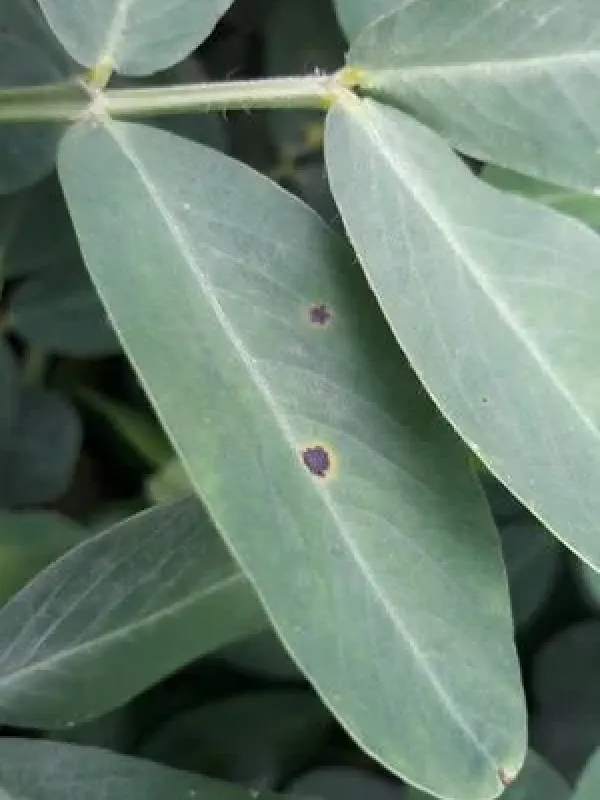
Symptoms initially appear as small, chlorotic spots on the foliage. As the infection progresses, these spots enlarge and become reddish-brown to dark-brown in color.
A distinctive feature of early leaf spot is the presence of a bright yellow halo around the lesions, which helps distinguish it from other types of leaf spots.
In humid conditions, the centers of the spots on the underside of the leaves become covered with a grayish or dark powdery mold, consisting of the fungus's conidiophores and conidia.
Severe infection leads to defoliation, where the leaves turn yellow and drop prematurely. This process typically starts from the lower part of the plant and moves upward.
In addition to leaves, the fungus can also infect stems and petioles, weakening the structural integrity of the plant and potentially causing damage to the pegs.
Pathogen
The pathogen causing early leaf spot in peanuts is the ascomycete fungus Mycosphaerella arachidis (anamorph: Cercospora arachidicola). It is a highly specialized fungus that targets the Arachis genus.
The fungus survives the winter on crop debris remaining in the field. During the growing season, it produces conidia that are disseminated by wind and splashing raindrops onto the canopy of the peanut plants.
The life cycle involves the germination of spores on the leaf surface, followed by penetration through stomata. Inside the leaf, the mycelium colonizes the tissue, leading to the formation of necrotic spots.
Under favorable conditions, the pathogen undergoes multiple infection cycles in a single season, leading to rapid disease development within a field.
Biological persistence in the soil allows the pathogen to re-emerge if susceptible host plants are grown in the same area without proper rotation or residue management.
Conditions for development
The development of Mycosphaerella arachidis is heavily favored by warm temperatures, typically ranging from +25°C to +30°C, combined with high humidity.
Prolonged leaf wetness, caused by rain, heavy dew, or overhead irrigation, is essential for spore germination and successful fungal entry into the leaf tissue.
High plant density creates a microclimate within the canopy that traps moisture and reduces air circulation, promoting the rapid spread of the pathogen.
Disease outbreaks are most common during the middle and late stages of plant growth, coinciding with periods of high rainfall and warm weather.
The pathogen spreads more quickly in fields where the previous season's crop residues were not properly incorporated into the soil.
Why it matters
Early leaf spot is globally recognized as one of the most economically damaging diseases of peanuts, capable of significantly reducing total crop yields.
The primary damage results from the loss of photosynthetic leaf area, which limits the plant's ability to produce energy for pod filling and maturation.
In addition to yield loss, infected plants produce seeds with lower oil and protein quality, directly impacting the market value of the crop.
Defoliation and weak pegs make the harvest process difficult, as a significant number of pods may be lost during digging if the stems are too brittle.
Management of this disease requires constant attention, as unchecked outbreaks can lead to complete loss of marketable quality in severely infected fields.
Protection
The most effective strategy for managing early leaf spot is crop rotation, ideally avoiding peanuts for at least three years to allow fungal inoculum to decline.
Deep plowing or burying crop residue immediately after harvest is a vital cultural practice to remove the primary source of infection for the next season.
Fungicide application is necessary in high-pressure areas. Preventative spraying based on weather forecasts and scouting is more effective than waiting for obvious symptoms.
Choosing resistant or tolerant peanut varieties is a long-term solution that reduces the dependency on chemical inputs and ensures higher yield stability.
- Practicing proper plant spacing to improve canopy airflow.
- Ensuring balanced fertilization to promote plant health and stress resistance.
- Frequent field scouting to identify and treat early infection spots before they spread.
Pathogens and affected parts
Affects crops · 1
Discussion
No discussions yet — be the first.