

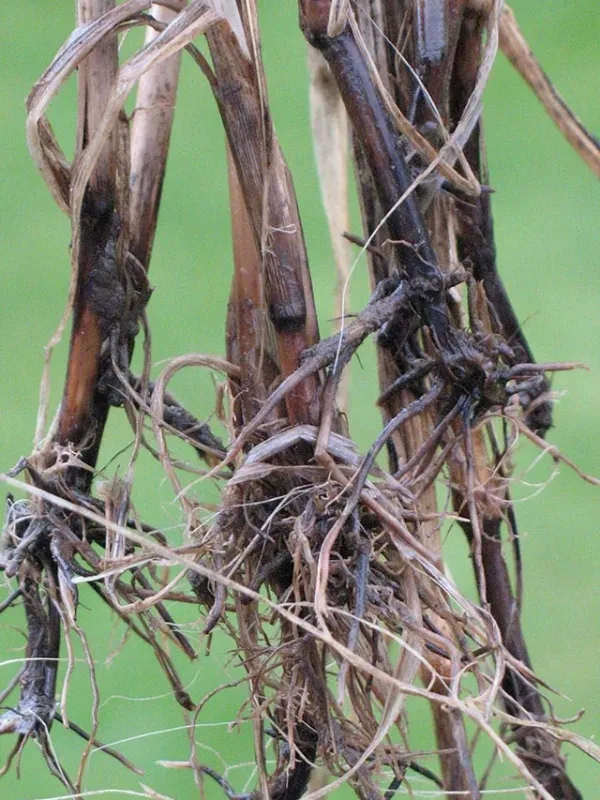
Description
Symptoms
Early symptoms appear during the tillering stage, with affected plants showing stunted growth and chlorosis. Infected seedlings may become yellow and fail to thrive in the early spring.
The most distinctive sign is the blackening of the stem base and the roots, which is why it is often referred to as 'black foot'. The roots become brittle, dark, and rotten, often leading to total root system collapse.
During the heading stage, infected plants often exhibit 'whiteheads'. These heads are prematurely bleached, empty, or contain shriveled, light-weight grains that significantly reduce yield quality.
Plants affected by take-all can be easily pulled out of the soil because their roots are severed. A dark, black fungal mat is often visible on the crown and lower stem area of these plants.
The disease typically manifests in patches throughout the field. These patches may be small initially but often expand in size, showing a clear disparity between healthy and infected plants.
Pathogen
The disease is caused by the fungus Gaeumannomyces tritici (formerly Ophiobolus graminis). It is a soil-borne pathogen that predominantly affects the root systems of wheat, barley, and other grasses.
The pathogen survives in the soil and on crop debris, primarily as mycelium. It colonizes the roots of susceptible host plants and thrives in the organic matter left after harvest.
Infection spreads through the soil by the growth of fungal runners (hyphae) from infected roots or crop residues to the roots of nearby healthy plants. The fungus does not typically spread through seeds.
The fungal mycelium invades the cortical tissues of the roots, causing necrosis and decay. This effectively stops the plant from absorbing necessary water and nutrients from the soil.
The life cycle of the pathogen is highly dependent on the presence of susceptible host plants. Continuous cropping of wheat allows the fungal population to build up to destructive levels over time.
Conditions for development
Take-all development is favored by mild, moist weather conditions, particularly during the autumn and spring. These conditions promote the rapid spread of the fungus in the soil.
Soil pH plays a critical role in disease severity. The fungus thrives in neutral to alkaline soils, whereas acidic soils significantly inhibit its growth and activity.
Monoculture of wheat or barley is the most significant factor in disease outbreaks. Growing the same host crop repeatedly provides an uninterrupted food source for the pathogen.
Soil compaction and poor drainage also contribute to disease susceptibility. Roots that struggle to grow in dense, poorly aerated soil are much more vulnerable to fungal invasion.
Grass weeds, such as couch grass, serve as alternative hosts for Gaeumannomyces tritici. They maintain the fungal population in the soil even when the main cereal crop is not present.
Why it matters
Take-all is one of the most damaging root diseases of wheat worldwide, with potential yield losses ranging from 20% to 50%. It severely limits the productivity of intensive cereal farming.
Infected crops show significantly lower tiller density and reduced grain filling. The plant's inability to take up nutrients leads to a dramatic drop in overall grain quality and thousand-kernel weight.
The disease increases plant stress, making crops more vulnerable to drought. Since the root system is compromised, plants cannot access water reserves in deeper soil layers.
The reduction in grain quality—characterized by shriveled kernels—renders the produce less suitable for milling and baking, impacting the economic value of the harvest.
Long-term economic impact includes the need for expensive soil management strategies and the abandonment of continuous cereal production, which often forces a shift in farming systems.
Protection
Crop rotation is the cornerstone of managing take-all. Rotating wheat with non-host crops like oilseed rape, pulses, or mustard for 2–3 years effectively breaks the disease cycle.
Improving soil fertility is essential. Balanced application of phosphorus and potassium helps roots grow stronger and makes them more resilient against fungal attack.
Good soil management, including effective stubble decomposition, is vital. Plowing down infected residue helps to reduce the inoculum level in the topsoil.
Monitoring soil pH is important; in some cases, adding nitrogenous fertilizers that acidify the soil can help reduce the severity of the infection.
- Delayed sowing to avoid peak fungal activity during early root development.
- Vigorous weed control to eliminate alternative grass hosts.
- Using systemic fungicide seed treatments to protect young seedlings.
- Avoiding the use of lime in fields known to have high take-all pressure.
Content graph
Connections · Take-all root rot
Most often together:
Marketplace
Products · 3

Coral c.s.
Джянгсу Агрохем Лабораторі Ко. Лтд., Чанжоу, Китай
Fungicides
0
0
·
43
No offers
—
Details
Community
Discussion
No discussions yet — be the first.