
Description
Symptoms
Initial symptoms appear as small, circular spots on the surface of the tubers. These spots are often slightly sunken compared to the healthy skin and may display a brown or pinkish-brown hue.
Over time, the affected areas expand, resulting in a dry, friable consistency. Unlike wet rots, surface Fusarium rot generally does not produce a foul odor or excessive liquid exudate.
Under conditions of high humidity, a faint white or pale pink mold may emerge on the surface of the lesions. This is the sporulation of the fungus, which serves as a primary source of secondary infection for adjacent healthy tubers in storage.
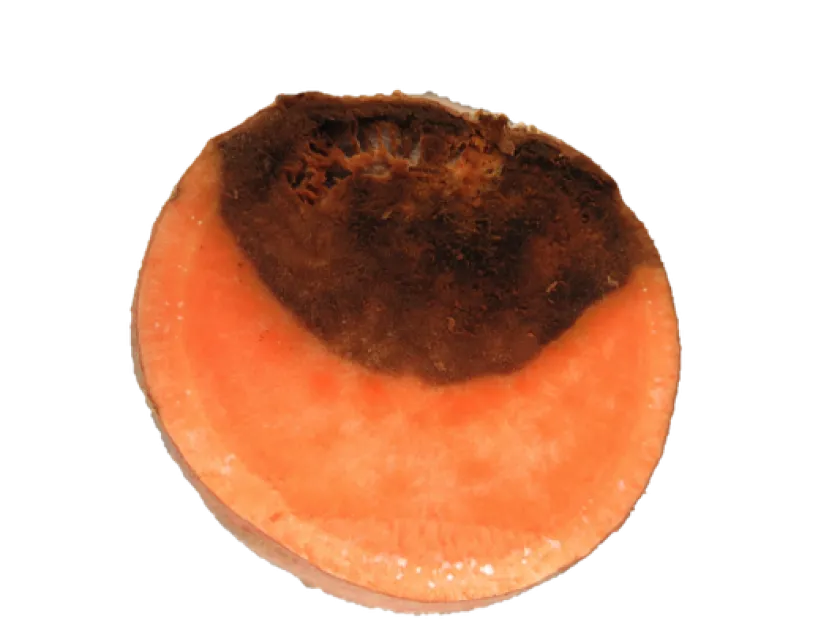
When the tuber is cut, the infected tissue reveals a brown or reddish-brown discoloration. The margin between healthy and diseased tissue is often blurry, although it may become more defined as the necrosis advances.
As the disease progresses, the tuber begins to shrivel and lose its marketability. Ultimately, the entire tuber can become a dry, brittle mass that is completely unfit for human consumption or processing.
Pathogen
The causal agent of this disease is the fungus Hypomyces ipomoeae (also known as Fusarium oxysporum f. batatas). This pathogen specializes in infecting sweet potato tissues both during the growing season and, most critically, during post-harvest storage.
The fungus is a soil-borne pathogen capable of surviving for long periods in plant debris, contaminated soil, and on farming tools. It infects tubers primarily through micro-cracks, wounds caused during harvest, or damage inflicted by soil-dwelling pests.
The pathogen spreads actively through spores, which can be moved by water, air currents, or physical contact with contaminated equipment and tubers. It exhibits significant adaptability to various soil types, making it a persistent threat in agricultural environments.
The life cycle of the fungus is strictly dependent on moisture levels, which are necessary for spore germination and colonization of host plant tissues. The fungal mycelium gradually penetrates deep into the tuber, breaking down cellular structures and triggering necrotic processes.
Surface Fusarium rot is recognized as one of the most significant post-harvest diseases of sweet potatoes worldwide. Without proper post-harvest management, this fungus can cause massive losses in storage facilities.
Conditions for development
The primary factor favoring the development of this disease is high humidity combined with moderately high temperatures. The fungus thrives in temperature ranges between 20 and 28 degrees Celsius.
Failure to properly cure (heal) the tubers immediately after harvest is a major factor in disease outbreaks. If tubers do not go through the necessary curing period to heal wounds, the risk of fungal entry increases significantly.
Poor ventilation within storage facilities creates stagnant zones with high relative humidity, which encourages the rapid spread of Hypomyces ipomoeae spores from infected units to healthy ones.
Mechanical injuries sustained during harvesting, washing, or sorting provide entry points for the pathogen. Increased physical damage leads directly to a higher incidence of infection in storage.
The presence of a high inoculum load in the soil or storage environment, often carried over from the previous season's debris, is the critical factor determining the severity of an outbreak.
Why it matters
The primary damage caused by this disease is the direct loss of harvest during storage. Infected tubers lose weight, lose their aesthetic appeal, and become completely unsuitable for food markets or processing.
The disease can be transmitted via infected planting stock (slips or storage roots). Planting contaminated materials leads to the immediate introduction of the pathogen into new fields, resulting in yield reductions.
Infection by this fungus often facilitates the onset of secondary rot, where bacteria or other opportunistic fungi invade the compromised tissue, turning dry rot into a more aggressive, faster-spreading mixed rot.
Economic losses are compounded by the costs of labor for sorting, discarding rotted produce, and the loss of revenue from reduced product quality. Infested batches require immediate disposal to prevent widespread loss.
On a farm-wide scale, massive outbreaks of Fusarium rot can threaten the overall economic viability of a sweet potato operation for the entire season.
Protection
- Implement a crop rotation schedule with at least a 3–4 year break to reduce soil inoculum.
- Thoroughly clean and sanitize storage facilities before introducing new harvests.
- Handle tubers with care during harvest to minimize mechanical damage and wounding.
- Perform mandatory curing of tubers for 7–10 days at optimal temperature and humidity to heal surface wounds.
- Use only disease-free, certified planting material to avoid introducing the pathogen to fields.
- Maintain stable storage temperatures and ensure efficient forced-air ventilation to keep humidity levels in check.
Pathogens and affected parts
Affects crops · 1
Discussion
No discussions yet — be the first.