
Description
Symptoms
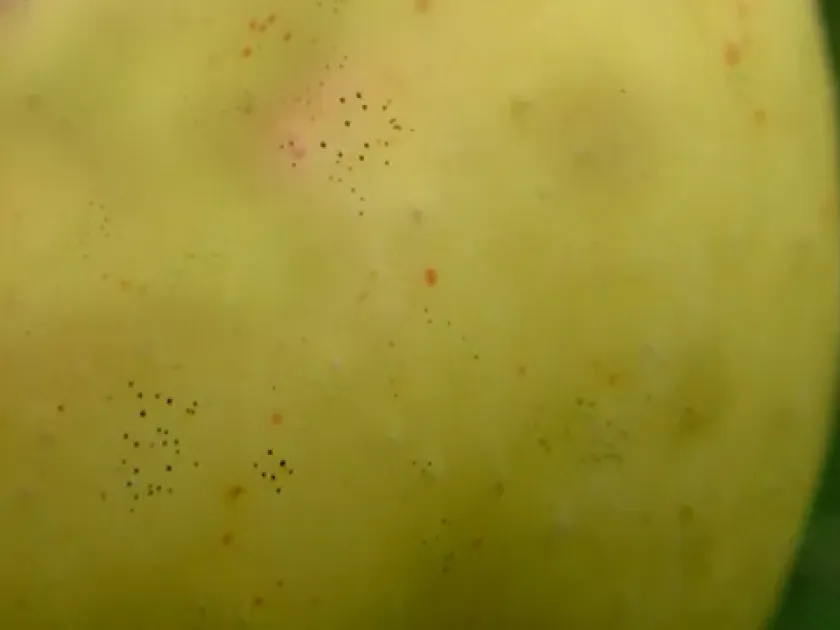
The main sign of the infection is the appearance of small, round, black or dark brown shiny specks on the fruit skin. They resemble fly droppings, which gave the disease its common name.
These spots can be scattered randomly or in clusters, sometimes merging into larger affected areas if conditions favor the intense development of the mycelium.
Under a magnifying glass, one can observe that the spots are superficial fungal structures (ascomata) and can be partially removed from the fruit skin surface mechanically.
The leaves of the affected plants can also be covered with specific blotches or spotting, although the symptoms are most contrastingly and noticeably visible on the fruit.
The development of symptoms often becomes most pronounced in the second half of summer or closer to harvest time, when humidity rises and the fruits acquire their base color.
Pathogen
The causal agent of the disease known as flyspeck is the ascomycete fungus Schizothyrium pomi. In its life cycle, this pathogen survives on fallen leaves and infected branches in the form of mycelium and fruiting bodies.
The disease affects a wide range of fruit crops, most frequently occurring on apple and pear trees. Symptoms have also been noted on citrus fruits and even on certain ornamental plants, such as Cattleya, under specific microclimatic conditions.
The infection process begins with spores landing on the surface of the fruit, where the fungus starts to form its characteristic colonies. The pathogen develops primarily within the epidermal layer without penetrating deep into the fruit pulp.
The life cycle of the pathogen is closely tied to climatic factors, allowing spores to disperse with rain droplets or wind throughout the entire growing season.
The biology of Schizothyrium pomi allows it to successfully overwinter in the orchard, forming a primary source of infection for the next season on last year's plant debris.
Conditions for development
The key factor in the development of flyspeck disease is high air humidity and moderately warm weather. The fungus actively progresses in orchards with dense, poorly ventilated canopies.
Prolonged rains and fog during the summer create an ideal environment for spore germination and the formation of colonies on the surface of the fruit epidermis.
The absence of proper sanitary pruning of trees contributes to moisture retention, which significantly increases the risk of widespread infection in a specific orchard.
In low-lying areas of the orchard where air circulation is poor and nighttime dew concentration is high, the pathogen manifests itself particularly aggressively.
The optimal temperature for mycelial growth is generally in the range of 18–25 degrees Celsius, which often coincides with the active ripening period of apples and pears.
Why it matters
The primary damage from flyspeck disease is a significant loss in the marketability of the produce. Fruits covered with "black dots" lose their consumer appeal.
Although the fungus does not cause internal rotting, affected fruits lose moisture more quickly during storage through the damaged skin, leading to premature shriveling.
Reduced fruit quality significantly impacts market value, downgrading the harvest from premium grades to non-marketable or industrial raw material categories.
When the infection is severe, a decrease in overall photosynthetic productivity may be observed due to leaf tissue damage, which indirectly weakens the tree.
Compromising the integrity of the fruit skin can facilitate the entry of other secondary infections, which cause full-scale rots during long-term storage.
Protection
The control strategy includes mandatory sanitary pruning of trees to ensure good canopy aeration and reduce internal humidity.
An important preventive measure is the timely removal and destruction of fallen leaves and infected fruit, which serve as reservoirs for fungal spores.
The use of fungicides in orchards is carried out according to the scab control schedule, as copper-based products and systemic fungicides are also effective against flyspeck.
- Regular thinning pruning.
- Collection and disposal of plant debris.
- Timely fungicide application during the growing season.
Choosing varieties resistant to fungal diseases is the most promising direction in reducing reliance on chemical crop protection products in horticulture.
Pathogens and affected parts
Affects crops · 4
Discussion
No discussions yet — be the first.