
Himalayan pine rust
Cronartium himalayense
Description
Symptoms
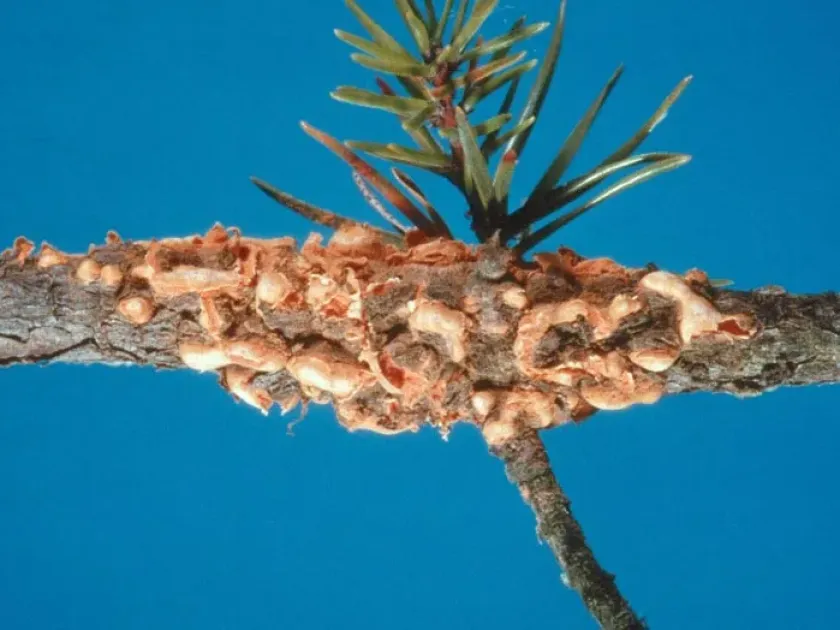
The first noticeable symptoms are characteristic swellings and canker-like growths on the stems and branches. In these areas, the bark cracks, revealing deep necrotic lesions.
During the spring spore production phase, bright orange or yellowish aecia pustules emerge on the infected bark. These appear as blister-like structures filled with a mass of spores.
Infected trees exhibit yellowing and premature needle shed within the canopy, which serves as a visual indicator of systemic stress and poor nutrient transport within the tree.
On alternate hosts (Swertia species), the disease manifests as small rusty-brown spots or pustules on the underside of leaves, which are particularly evident during the summer months.
Over time, the infected branches become brittle and break easily, leading to significant crown deformation and a reduction in the tree's overall vigor and aesthetic quality.
Pathogen
The causative agent of this disease is the specialized rust fungus Cronartium himalayense. It is an obligate parasite and a heteroecious fungus, requiring two different hosts to complete its complex biological life cycle.
The primary host is the Chir pine (Pinus roxburghii), where the fungus forms its aecia. The fungal mycelium penetrates the bark and wood of the stems and branches, causing significant structural changes in the host plant tissues.
The alternate hosts for the fungus include various species of the genus Swertia, such as Swertia chirayita. These herbaceous plants support the development of urediniospores and teliospores, which facilitate overwintering and disease spread.
The lifecycle involves several spore stages, including aeciospores, urediniospores, and teliospores, each timed to specific seasonal conditions and the availability of the host plants.
The pathogen develops slowly within the pine tissue, allowing it to persist in the tree for many years while gradually exhausting its nutrient reserves and disrupting the vascular system.
Conditions for development
High humidity and moderate temperatures significantly favor the development and spread of the fungus. Spores are easily carried by wind over long distances to infect healthy stands.
Prolonged rainfall provides optimal moisture on the bark surface, which is essential for the germination of aeciospores and their successful penetration into the living tissue.
The proximity of alternate hosts (Swertia species) to pine plantations is a critical factor, as it sustains the pathogen's presence and increases the intensity of annual outbreaks.
Dense forest stands with poor airflow create a humid microclimate within the canopy, which is highly favorable for the rapid colonization of the fungus on stressed trees.
Trees experiencing physiological stress, such as drought or mechanical damage, are significantly more susceptible to infection compared to healthy, vigorous trees.
Why it matters
The primary damage caused by Cronartium himalayense is the substantial reduction in wood growth and productivity, leading to significant economic losses in forest management.
Young trees are particularly vulnerable, often dying due to girdling infections on the main stem, which disrupts the flow of water and nutrients to the upper parts of the plant.
In mature trees, the rust disease makes the host more susceptible to secondary infections by pathogens and pests, which collectively accelerate the tree's decline and death.
Timber from infected trees loses its mechanical strength and structural integrity, rendering it unsuitable for industrial processing and high-quality wood products.
Furthermore, the ecological impact includes the loss of biodiversity within forest ecosystems and the high cost associated with reforestation and site management following an outbreak.
Protection
The primary control strategy involves maintaining spatial isolation between pine plantations and areas where alternate hosts (Swertia) are abundant to break the disease cycle.
Sanitation cutting, which involves the prompt removal and destruction of infected trees, is crucial for reducing the inoculum load and preventing further spread within the stand.
Regular monitoring of forest areas allows for the early detection of rust symptoms, enabling foresters to isolate and manage small outbreaks before they become widespread.
Site selection is also important; avoiding planting pine in high-humidity areas or locations known to harbor alternate hosts can significantly lower the risk of infection.
In nurseries, the application of targeted fungicides during the critical periods of spore production helps protect seedlings and ensures that the planting stock remains healthy.
Discussion
No discussions yet — be the first.