
Pine blister rust
Cronartium coleosporioides
Description
Symptoms
The most prominent sign of infection is the development of distinct swellings or galls on the bark of stems and branches. Early symptoms may appear as slight discoloration and tissue bulging on the surface.
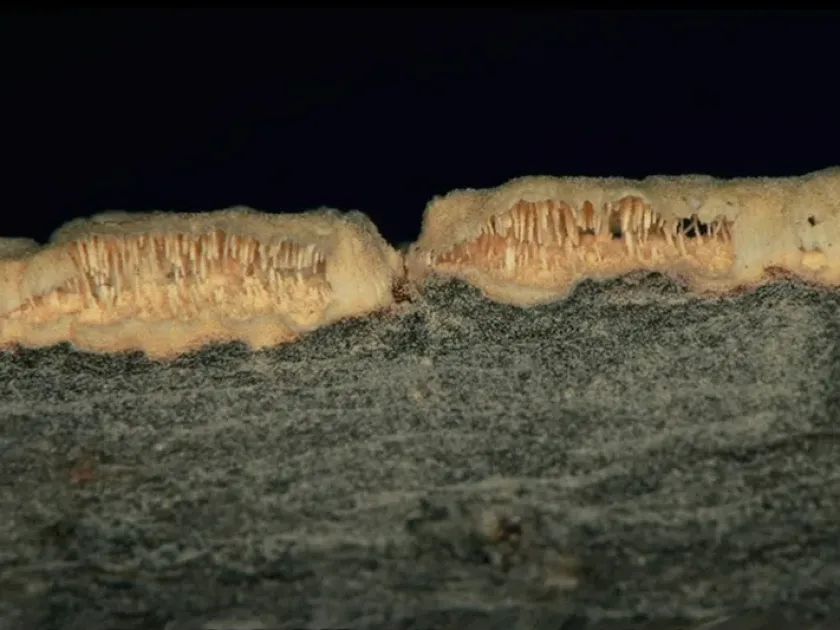
In spring, the bark at the swelling site ruptures, revealing numerous bright orange or yellow blisters. These are the aecia, which contain masses of spores that are easily released into the air.
After the spores are released, the area often develops open wounds, cankers, or deep cracks in the bark. Trees frequently exhibit profuse resin flow, known as pitch soaking, as a defensive reaction to the fungus.
The crown of an infected tree often shows signs of stress, including chlorotic needles, premature needle drop, and the dying off of individual branches. This foliage loss results from the disruption of nutrient and water flow.
Over time, the infection can girdle the stem, leading to the death of the tree crown above the point of infection. Persistent damage can cause the stem to become distorted or weaken significantly.
Pathogen
The disease is caused by the heteroecious rust fungus Cronartium coleosporioides, belonging to the Basidiomycota division. Its life cycle requires two distinct plant hosts to complete its complex development.
The primary host is the pine tree, where the fungus colonizes the inner bark and cambium of stems and branches. The secondary host, which supports other stages of the life cycle, includes various species of willows or certain herbaceous plants.
The pathogen typically enters the tree through wounds or needles, after which the mycelium grows throughout the phloem. This infection is systemic and chronic, persisting inside the tree for many years.
The life cycle involves the formation of aeciospores on the pine bark in the spring, which are dispersed by wind. These spores infect the secondary host, leading to the development of subsequent spore stages.
For the infection to return to the pine, basidiospores produced on the secondary host must land on young pine needles or buds under moist conditions. This completion of the cycle is necessary for the ongoing spread of the rust.
Conditions for development
High humidity and mild temperatures during the spring are ideal for the disease development. Rainfall and fog facilitate the rupture of the blisters and the successful dispersal of spores to new hosts.
The presence of susceptible alternate hosts, such as willows, in close proximity to pine stands significantly increases the risk of infection. Proximity allows for effective transmission of spores back and forth.
Trees that are weakened by environmental stress, such as drought, nutrient deficiencies, or previous mechanical injuries, are far more susceptible to successful colonization by the fungus.
Optimal conditions for fungal development occur at temperatures ranging from 15°C to 20°C combined with high atmospheric moisture. Poor air circulation in dense plantations further promotes the spread.
Micro-wounds in the bark, whether caused by frost, insect damage, or pruning, provide easy entry points for the pathogen, making infection more likely in vulnerable environments.
Why it matters
Pine blister rust is highly destructive, particularly in young pine plantations and nursery settings. It can cause significant mortality among young seedlings, leading to substantial economic losses.
In mature trees, the infection disrupts the vascular system, which leads to reduced timber growth and decreased wood quality. The lumber from infected trees is often downgraded due to resin pockets and decay.
Infected trees become highly susceptible to secondary attacks by wood-boring insects and bark beetles. This cumulative stress frequently results in the rapid death of the host tree.
Structural weakness at the site of the canker makes infected trees prone to wind breakage. This creates hazardous conditions in forest areas and recreational parks.
Because the disease is chronic, infected trees act as reservoirs for spores. This makes them a continuous threat to the health of surrounding healthy trees for many years.
Protection
The most effective strategy for control is the early identification and removal of infected trees. Regular sanitation thinning helps to reduce the inoculum levels within the forest.
Management of the landscape is crucial. Removing alternate hosts within a sufficient buffer zone around nurseries and young pine stands is a primary preventative measure.
Selecting and planting rust-resistant pine varieties is the best long-term approach for maintaining healthy forests. Using certified, disease-free nursery stock is essential.
In intensive nursery operations, the application of fungicides during the sporulation period can protect young plants from primary infections if environmental conditions favor the disease.
- Removal and destruction of infected branches or whole trees.
- Creating spatial buffers between pines and secondary hosts.
- Pruning lower branches to reduce entry points.
- Regular monitoring of pine stands during spring.
Discussion
No discussions yet — be the first.