
Description
Symptoms
The primary symptom of corn stunt is the excessive proliferation of axillary shoots, giving the plant a distinctive bushy or "witches' broom" appearance.
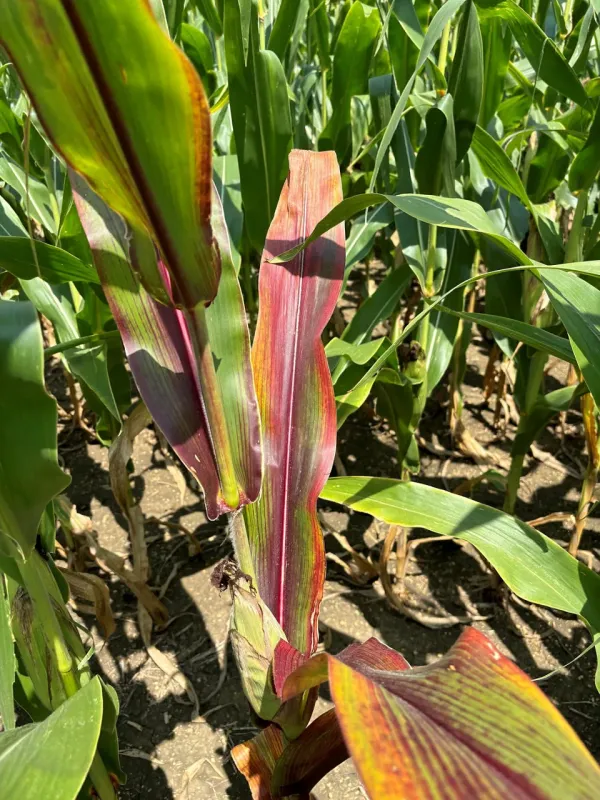
Foliage typically develops chlorosis starting from the leaf margins, which later progresses into a reddish or purplish discoloration during the flowering stage.
Internode shortening is commonly observed, resulting in stunted, dwarfed plants that appear physically deformed compared to healthy stalks.
Ear development is severely impacted; plants may remain barren or produce small, deformed ears with poorly filled, shriveled kernels.
Root systems are frequently underdeveloped, leading to premature plant senescence and reduced ability to withstand environmental stressors like drought.
Pathogen
The disease is caused by Spiroplasma kunkelii, a wall-less mollicute bacterium that resides in the phloem tissue of the host plant.
This pathogen is an obligate parasite, meaning it cannot survive for long periods outside of a living plant host or its insect vector.
As a systemic pathogen, it travels throughout the corn plant's vascular system, causing metabolic disturbances and disrupting nutrient transport.
The bacterium has a specialized relationship with its vector, the corn leafhopper, within which it also multiplies during the incubation period.
Because of its phloem-limited nature, it is essentially dependent on insect vectors for transmission from one plant to another in the field.
Conditions for development
The spread of corn stunt is inextricably linked to the population dynamics of the corn leafhopper, Dalbulus maidis.
The disease thrives in warm, tropical, and subtropical climates where temperatures facilitate rapid insect reproduction and pathogen incubation.
High humidity and mild winters allow for continuous cycles of the vector, which serves as a perennial reservoir for the spiroplasma.
Migratory patterns of the leafhoppers from infested fields to new seedlings are the most critical factor for the onset of an epidemic.
The presence of volunteer corn or alternative weed hosts acts as a bridge, maintaining the pathogen in the landscape between corn growing seasons.
Why it matters
Corn stunt can be devastating, frequently causing yield losses ranging from 50% to over 90% in susceptible fields where early infection occurs.
Infected crops suffer from poor grain quality, which significantly reduces the market value and nutritional output of the harvest.
The structural integrity of the plant is compromised, making crops highly susceptible to lodging, which complicates mechanized harvesting operations.
In addition to grain yield, the biomass quality for silage is degraded, representing a major financial hit to integrated farming and livestock operations.
Widespread occurrence of the disease can lead to abandonment of corn cultivation in regions with high infection pressure if no control measures are taken.
Protection
Integrated management is essential, focusing primarily on the elimination of volunteer corn and weeds that host both the pathogen and the leafhopper.
The use of genetically resistant or tolerant corn hybrids is currently the most effective long-term strategy to mitigate the impact of corn stunt.
Application of systemic insecticides at planting or early growth stages can help reduce initial colonization by leafhopper vectors.
Adjusting planting dates to avoid peak vector activity periods can assist in lowering the incidence of early-season infection.
- Monitor leafhopper populations using yellow sticky traps regularly.
- Implement strict field sanitation after harvest to destroy infected crop debris.
- Maintain spatial separation between early-planted and late-planted corn fields.
Pathogens and affected parts
Affects crops · 1
Discussion
No discussions yet — be the first.