
Cotton anthracnose
Colletotrichum gossypii
Description
Symptoms
The first symptoms appear on seedlings as reddish-brown lesions on the hypocotyl, often causing the seedling to collapse, a condition commonly known as seedling blight or damping-off.
On adult leaves, the infection manifests as circular spots with dark margins. Over time, these spots produce fungal spore masses, and severely affected leaves eventually wither and fall off the plant.
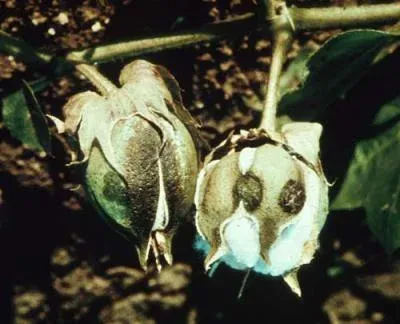
Bolls are particularly susceptible; the disease appears as sunken, dark-colored lesions. As the fungus spreads inward, it rots the developing fiber and seeds, rendering the boll useless.
During periods of high humidity, a pinkish or greyish layer of fungal spores becomes visible on the surface of the lesions inside the bolls, which is a key diagnostic indicator.
Stems can also exhibit elongated, sunken lesions that disrupt the transport of nutrients and water, often causing individual branches to wilt and die prematurely.
Pathogen
The disease is caused by the fungus Colletotrichum gossypii. This pathogen survives in soil, on infected crop debris, and within cotton seeds as dormant mycelium or spores.
The life cycle of the fungus involves the formation of acervuli, which are dark-colored pads producing masses of conidia. These spores are spread primarily by wind, splashing rain, and insects throughout the growing season.
This pathogen specifically targets cotton (Gossypium spp.). It can persist in the soil as a saprophyte, meaning it can live on dead organic matter, making eradication from a field a long-term challenge.
Infected seeds are the primary source of initial outbreaks. If the seed is not treated, the fungus quickly infects the emerging hypocotyl, leading to damping-off and seedling mortality.
The biological nature of this fungus allows it to adapt to various environmental conditions, remaining dormant during periods of drought and becoming active when moisture levels increase.
Conditions for development
Cotton anthracnose thrives in warm, humid climates. The fungus requires high relative humidity and temperatures between 20°C and 28°C for optimal spore germination and colonization.
Frequent rainfall and heavy dews during the boll-filling stage significantly increase the risk of an epidemic, as splashing droplets transfer spores to healthy plant parts.
High plant density creates a microclimate with poor air circulation, trapping moisture within the crop canopy and allowing the fungus to spread rapidly from plant to plant.
Excessive nitrogen fertilizer promotes rapid, succulent growth, which is more susceptible to fungal entry compared to tissues hardened by balanced potassium fertilization.
Poorly drained soils or waterlogged fields exacerbate the disease, as stress lowers the natural defense mechanisms of the cotton plant, making it easier for C. gossypii to penetrate.
Why it matters
The most immediate impact is stand loss, as the fungus kills seedlings before or shortly after emergence, often requiring expensive replanting of the field.
Anthracnose severely degrades fiber quality. The rot destroys the fiber's structure, causing it to become brittle and discolored, which results in significant economic loss at harvest.
Infected bolls produce poor-quality, low-germination seeds, which carry the pathogen into the following season, perpetuating the cycle of the disease across the farm.
Systemic weakness caused by stem and leaf infections reduces the plant's overall photosynthetic capacity, limiting the number of bolls produced and the total yield weight.
In severe cases of epidemic development, losses can exceed 50% of the harvest, making consistent management of the disease vital for the financial viability of cotton farming.
Protection
Seed treatment with systemic fungicides is the first and most critical defense. This protects the vulnerable seedling from initial infection carried by the seed itself.
Crop rotation is essential; waiting 3 to 4 years before replanting cotton in the same field helps break the cycle of the fungus, which would otherwise persist in the soil debris.
Deep plowing after harvest helps bury infected plant material, accelerating its decomposition and reducing the inoculum levels available for the next planting season.
Foliar application of fungicides during the growing season can suppress the disease if applied at the first sign of symptoms, particularly during wet weather periods.
- Using resistant or tolerant cotton varieties
- Managing plant spacing to improve canopy aeration
- Controlling boll-damaging insects that create infection entry points
- Applying balanced fertilization, specifically potassium
Discussion
No discussions yet — be the first.