
Description
Symptoms
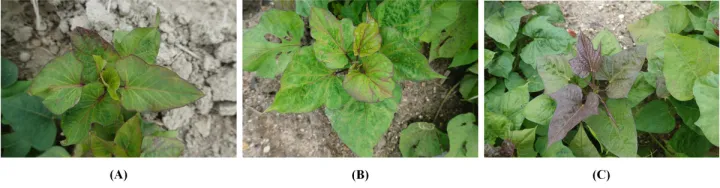
The characteristic symptoms include severe stunting and chlorosis of the foliage. The plant's growth is severely retarded, leading to a diminished and poor-quality root system.
Leaves often display yellowing, which can be interveinal, and may exhibit curling, wrinkling, or other malformations. In advanced stages, premature leaf drop may be observed.
Because the disease often involves a synergistic complex, symptoms can appear much more aggressive than those caused by a single virus. The plant typically looks pale and lacks vigor.
The storage roots (tubers) formed on infected plants are often significantly smaller in size, deformed, or reduced in quantity, which directly impacts the commercial yield.
Visual identification can be challenging because symptoms can be confused with nutritional deficiencies or environmental stress, making laboratory diagnostic testing necessary for confirmation.
Pathogen
The causative agent of this disease is a viral complex, with the Sweet potato chlorotic stunt virus (SPCSV) being the primary pathogen. It belongs to the genus Crinivirus and is known for affecting the plant's vascular tissue.
The disease frequently occurs as a coinfection with other viruses, such as the Sweet potato feathery mottle virus (SPFMV). This synergistic interaction significantly enhances the severity of symptoms and the overall viral titer in the plant.
The virus is an obligate parasite that replicates within the host cells. It does not spread through soil or mechanical contact between plants, which is a critical point for disease management.
The virus is transmitted by insect vectors, primarily whiteflies such as Bemisia tabaci. The insects acquire the virus during feeding and subsequently inoculate healthy plants during the phloem-feeding process.
Upon entry, the virus disseminates throughout the phloem, establishing a systemic infection that eventually impacts the entire physiological development of the sweet potato plant.
Conditions for development
The development of the disease is highly dependent on the population dynamics of the whitefly vector. Warm, humid conditions favor vector reproduction, leading to faster viral transmission across fields.
The primary inoculum source is infected planting material (cuttings or tubers). Since the virus is systemic, every piece of vegetative material propagated from an infected plant will carry the disease.
Wild species in the Convolvulaceae family can serve as reservoirs for the virus, maintaining the pathogen in the field environment between growing seasons.
Poor greenhouse management and the lack of sanitation during the propagation phase are major factors contributing to the widespread distribution of infected nursery stock.
Global movement of sweet potato germplasm without strict quarantine and virus-indexing protocols has facilitated the spread of the virus to new regions.
Why it matters
Sweet potato chlorotic stunt is a major limiting factor in production, leading to significant yield losses. The reduced photosynthetic capacity directly correlates with lower tuber mass and quality.
The economic impact is two-fold: not only does it result in lower yields, but it also renders the tubers less marketable due to their small size and poor visual condition.
Continuous use of infected tubers for propagation over successive cycles leads to the complete degradation of a variety, eventually making it impossible to produce a viable crop.
Plants weakened by the virus become more susceptible to other biotic and abiotic stresses, further reducing the overall stability of the farming operation.
In regions where the virus is endemic, it is considered one of the most destructive diseases, frequently forcing farmers to abandon susceptible varieties in favor of virus-tolerant alternatives.
Protection
The most important control measure is the use of virus-indexed, disease-free planting material derived from meristem culture programs to ensure the stock is clean from the start.
Implementing an Integrated Pest Management (IPM) program is essential to maintain low whitefly populations through the targeted use of insecticides and biological control agents.
Sanitation practices such as rogueing (removing and destroying symptomatic plants) are crucial to prevent the local spread of the virus within the field.
Establishing spatial isolation between newly planted fields and older, potentially infected sites reduces the risk of insect-mediated transmission of the pathogen.
- Control of weed reservoirs in and around the fields.
- Using fine-mesh netting in nurseries to exclude whiteflies.
- Ensuring thorough cleaning and disinfection of tools used for propagation.
Pathogens and affected parts
Affects crops · 1
Discussion
No discussions yet — be the first.