
Description
Symptoms
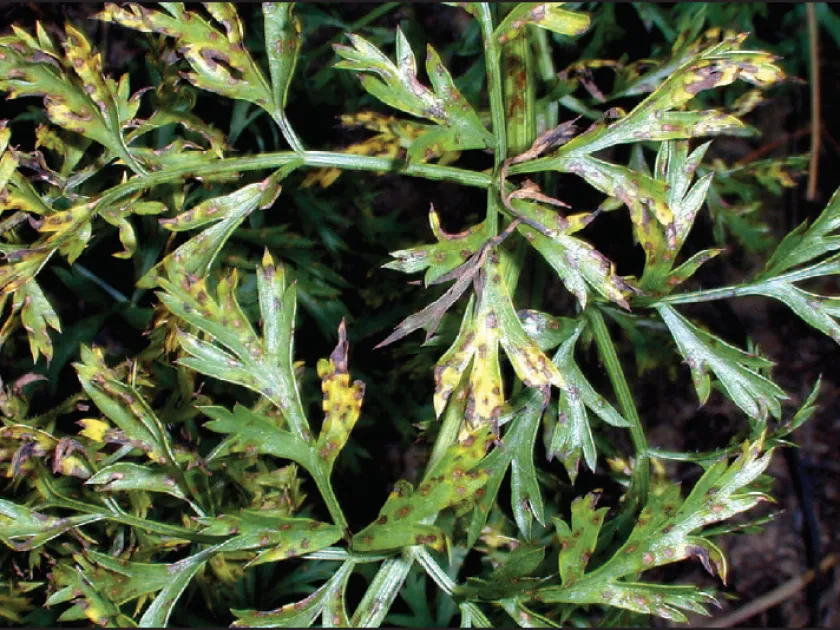
The disease is characterized by a stunting of the plant and distinct leaf discoloration, commonly known as mottling, where leaves appear yellow or reddish.
Leaves often exhibit severe curling, twisting, or crinkling, leading to a reduced canopy size that affects the photosynthetic efficiency of the carrot plant.
Infected carrots show significant growth reduction, with the taproot failing to develop properly, becoming small, woody, or misshapen during maturation.
Symptoms vary depending on the plant growth stage at the time of infection; earlier infections generally lead to more severe stunting and lower yields.
The characteristic red and yellow mottling patterns are diagnostic, making it relatively easy to distinguish from nutritional deficiencies by a trained agronomist.
Pathogen
Carrot Motley Dwarf is caused by a complex of two viruses, typically the Carrot red leaf virus and the Carrot mottle virus, which act in synergy to produce severe symptoms.
The disease is transmitted primarily by the willow-carrot aphid, which acquires the virus while feeding on infected plants and transmits it to healthy ones.
As an obligate virus complex, it relies entirely on the host plant for replication and cannot survive long periods outside of a living host or its insect vector.
This pathogen complex has a broad host range, often affecting related Apiaceae species and potentially impacting crops like peppers or tomatoes grown in the vicinity.
The viruses persist in overwintering carrot crops or in perennial weeds, which act as primary inoculum reservoirs at the beginning of the new growing season.
Conditions for development
The spread of this disease is heavily dependent on the migration patterns of the aphid vector, which is often influenced by warmer spring and summer temperatures.
Environmental stress, such as drought, can exacerbate the impact of the disease by weakening the plant's overall vigor and making it more susceptible to virus load.
Proximity to infected overwintered carrot fields or patches of wild host plants significantly increases the likelihood of a rapid disease outbreak on new crops.
High population densities of aphids in early spring correlate strongly with increased incidences of the disease in commercial carrot production fields.
Poor field sanitation, including the presence of infected carrot volunteers or nearby weed patches, creates an environment where the virus can spread unchecked.
Why it matters
The primary economic harm is the dramatic reduction in yield, as infected plants produce stunted, non-marketable roots that fail to meet commercial standards.
Beyond quantity, the quality of the carrot root is degraded, as the taproot becomes fibrous and develops poor flavor, making it unsuitable for processing.
The disease disrupts the normal physiological cycle of the carrot, leading to early senescence and the premature death of the foliage, which prevents root bulking.
Infested fields may experience total crop failure if the infection occurs shortly after seedling emergence, causing massive losses for the grower.
The management of this disease adds significant costs to production due to the necessity of intensive insecticide applications to control aphid populations.
Protection
Integrated pest management, specifically the targeted use of systemic insecticides to manage aphid vectors, is the most effective way to slow down virus spread.
Implementing a spatial separation between new carrot sowings and overwintered carrot crops is a vital strategy to avoid early aphid-borne infections.
Strict weed control measures should be employed both in the field and around its perimeter to remove potential virus reservoirs that harbor the aphid vectors.
Planting dates can be adjusted in some regions to avoid the peak flight period of the aphid vectors, thus significantly reducing the initial infection pressure.
Using certified, healthy seeds and selecting carrot cultivars with known tolerance or resistance to the virus complex is the best long-term management strategy.
Pathogens and affected parts
Affects crops · 1
Discussion
No discussions yet — be the first.