
Northern Corn Leaf Spot
Bipolaris zeicola
Description
Symptoms
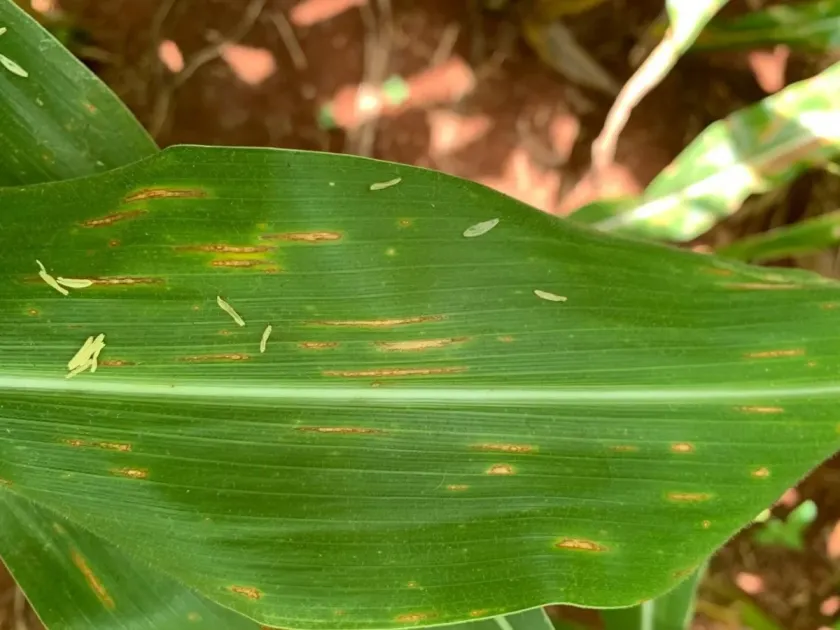
Early symptoms appear as small, tan or brown, oval-shaped spots on the lower leaves. These lesions often have a distinctive dark border or a yellow halo, distinguishing them from other leaf spot diseases.
Under high humidity, the lesions show a characteristic olive-black velvet-like fungal growth, which is the sporulation of the pathogen. This growth is visible to the naked eye when examining the leaf underside.
As the disease progresses, lesions coalesce and cover larger areas of the leaf blade, causing significant blight and premature leaf senescence. In severe cases, the entire leaf may dry out and die.
The fungus can also infect ear husks and kernels. When kernels are affected, they may show dark discolorations and a fuzzy growth, which significantly reduces the quality and marketability of the harvest.
Diagnosis in the field is based on lesion appearance and the presence of fungal growth, but laboratory testing may be required to confirm Bipolaris zeicola, as it can be confused with other Helminthosporium species.
Pathogen
Northern corn leaf spot is caused by the fungus Bipolaris zeicola, which was formerly known as Helminthosporium carbonum. It is a fungal pathogen that primarily affects maize, causing significant damage in humid environments.
The pathogen survives the winter as mycelium on infected crop debris and in the soil. Under favorable conditions, it produces conidia that are dispersed by wind or splashing rain to infect healthy corn tissues.
Bipolaris zeicola is known for its narrow host range, specifically targeting maize. The fungus penetrates the leaf surface, colonizing the tissue and producing characteristic necrotic lesions that expand over time.
There are several physiological races of this fungus, which vary in their aggressiveness and ability to infect specific corn hybrids. This makes disease management dynamic and dependent on local pathogen populations.
The infection cycle can repeat multiple times during a single growing season if weather conditions remain conducive to fungal sporulation and growth. This secondary infection cycle is the primary driver of disease epidemics in corn fields.
Conditions for development
The development of northern corn leaf spot is heavily dependent on moisture. High relative humidity and frequent rainfall are the most critical factors for the germination of fungal spores.
Temperature plays a significant role, with the fungus thriving in moderate to warm conditions, typically ranging between 20°C and 28°C. These conditions are most common mid-to-late summer.
Monoculture or tight crop rotations are major contributors to disease prevalence. Planting corn in the same field for consecutive years allows the pathogen population to build up on surface crop residues.
Poor field ventilation, often caused by high planting density, creates an ideal microclimate for the pathogen to thrive. Stagnant air and persistent moisture on leaf surfaces facilitate rapid colonization.
Plants that are stressed due to nutrient deficiencies, drought, or insect damage are more susceptible to infection. Maintaining overall crop health is essential to reducing the severity of the disease.
Why it matters
The primary economic impact of this disease is the reduction of photosynthetic capacity. By destroying leaf tissue, the fungus reduces the plant's ability to fill kernels, leading to lower yields.
Severe infestations can lead to weakened stalks, as the fungus can compromise the integrity of the plant tissues, increasing the risk of lodging. Lodged corn is difficult to harvest and often results in significant losses.
Seed quality is severely impacted by the disease. Infected ears produce grain that is lighter, shriveled, and may contain mycotoxins, making it unsuitable for feed or food processing.
The loss of leaf area significantly reduces the plant's carbohydrate reserves, making it less resilient to environmental stressors during the grain-filling stage of development.
In cases of heavy disease pressure, total harvestable yield can drop by 15-30%. The costs associated with fungicide applications and potential crop insurance claims further add to the financial burden on farmers.
Protection
Genetic resistance is the most effective and sustainable method for managing northern corn leaf spot. Growers should select hybrid varieties known for their tolerance or resistance to local strains of the pathogen.
Cultural practices are essential for reducing primary inoculum. Incorporating crop residues into the soil through deep plowing helps accelerate decomposition, thereby reducing the amount of fungus that survives the winter.
Fungicide applications, particularly those utilizing triazoles and strobilurins, are recommended when disease pressure is high. Early detection is crucial to ensure that sprays are applied before the infection reaches the ear leaves.
Balanced fertilization programs, particularly those ensuring adequate potassium levels, help the plant maintain strong cell walls and overall resistance to fungal infection throughout the season.
- Use of disease-free, high-quality certified seed.
- Implementing a 2-3 year crop rotation with non-host crops.
- Timely scouting of fields to identify early-stage infections.
- Maintaining optimal planting density to promote air movement.
Discussion
No discussions yet — be the first.