

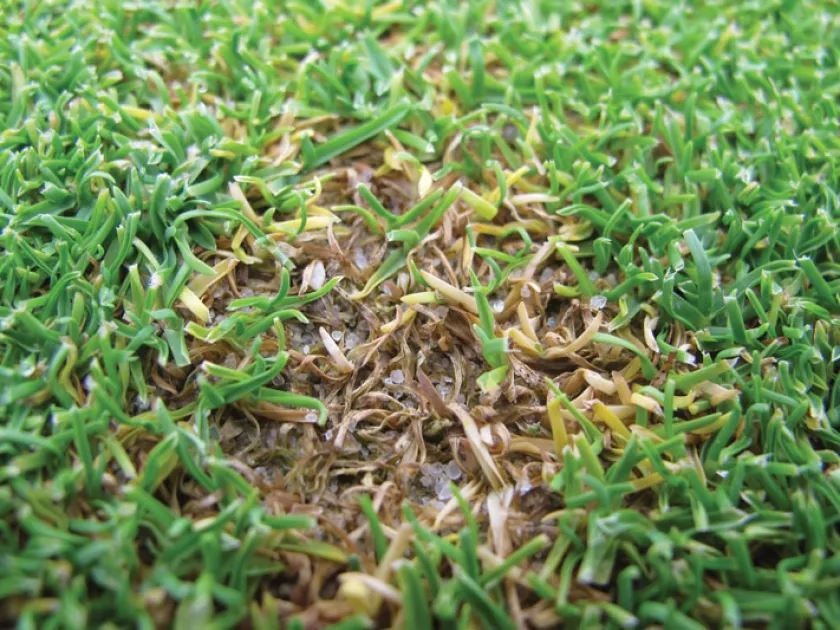
Description
Symptoms
A key sign of the disease is the development of root rot, where roots darken and gradually die. In the initial stages of infection, one can notice browning or blackening of both primary and secondary roots.
The appearance of diseased plants deteriorates significantly: growth retardation and general stunting of shoots are observed. In cases of severe infection, plants become chlorotic, and leaves begin to yellow, starting from the lower levels.
Upon examination of the root collar, one can find necrotic spots that often spread to the sheaths of the lower leaves. Damage to the vascular system of the roots hinders the flow of nutrients and water to the aerial part of the plant.
In high humidity conditions, a specific mycelial coating or fungal sporulation may form on the affected root areas and the crown zone, although this is often difficult to see without special equipment.
A critical period for symptom manifestation is the tillering phase, when the consequences of root damage become most evident in the form of thinning stands or the appearance of stunted plant patches.
Pathogen
The causal agent of this disease is the microscopic fungus Microdochium bolleyi (synonym Idriella bolleyi). This pathogen belongs to the mitosporic fungi group and is widely distributed in soils across the globe.
The fungus leads a predominantly saprotrophic lifestyle, inhabiting plant debris, but under favorable conditions, it exhibits parasitic properties. It can persist in the soil for long periods as mycelium or chlamydospores, waiting for a susceptible host.
The most common target for infection is winter wheat, although the pathogen can also infect barley, rye, and various types of grasses.
Infection occurs through the root system or seedlings that come into contact with soil containing the inoculum. Active development of the mycelium leads to colonization of plant tissues and disruption of their normal physiological functions.
A biological feature of the pathogen is its ability to coexist with other fungal pathogens that cause root rot, which often complicates accurate diagnosis in field conditions without laboratory analysis.
Conditions for development
Disease development is closely linked to soil temperature. The fungus is moderately cold-loving, so the most active infection occurs during cool and wet weather, typical for autumn or early spring.
High soil moisture is a key factor promoting spore germination and rapid penetration of the mycelium into host tissues. Waterlogging in fields significantly increases the risk of epidemic pathogen development.
Agricultural mismanagement, such as monoculture (planting wheat after wheat), creates ideal conditions for the accumulation of inoculum in the soil. Without crop rotation, the fungal population increases annually.
Deficiencies in nutrient elements or unfavorable soil pH weaken the plant's natural immunity, making them more susceptible to Microdochium bolleyi. Stressed plants are infected much faster.
Sowing depth also plays a role: excessively deep sowing weakens seedlings, extending their vulnerability period to soil pathogens, which facilitates easier fungal invasion.
Why it matters
The main danger of Microdochium blight is a significant reduction in plant density, which directly leads to yield loss. Affected crops are often thin, limiting the realization of the variety's production potential.
The disease negatively impacts root system development, leading to impaired plant nutrition during critical growth stages. This results in a reduction in the number of productive stems and grain weight per ear.
In cases of early-stage infection, massive seedling death can occur, which requires reseeding or significantly reduces the quality of winter crops after overwintering.
Plants damaged by the fungus become more sensitive to other stressors, including frost, drought, or secondary rots, which often finish off the already weakened tissues.
In large-scale grain production, the presence of this disease leads to lower grain grading due to shriveling and a reduction in protein and gluten content.
Protection
The most important preventive measure is strict adherence to crop rotation. Eliminating repeated wheat planting on the same field for 2–3 years significantly reduces the infectious background in the soil.
Seed treatment with high-quality fungicides is a mandatory protection measure that provides an initial barrier against infection penetration during the early growth stages.
Agronomic practices aimed at soil health include timely incorporation of crop residues and deep plowing, which promote accelerated decomposition of plant debris where the fungus persists.
Optimizing sowing dates allows seedlings to avoid periods with the most favorable temperature conditions for the pathogen. Healthy, rapidly developing plants have a better chance of resisting the fungus.
- Application of balanced fertilizers (phosphorus, potassium) to strengthen cell walls.
- Use of resistant or tolerant wheat varieties.
- Control of soil moisture in poorly drained areas.
In brief
1
Affects crops
Biology
Pathogens and affected parts
Affected plant parts
whole plant
Content graph
Affects crops · 1
Content graph
Connections · Microdochium blight
Most often together:
Marketplace
Products · 1
Community
Discussion
No discussions yet — be the first.