
Browntop millet
Urochloa ramosa (L.) T. Q. Nguyen
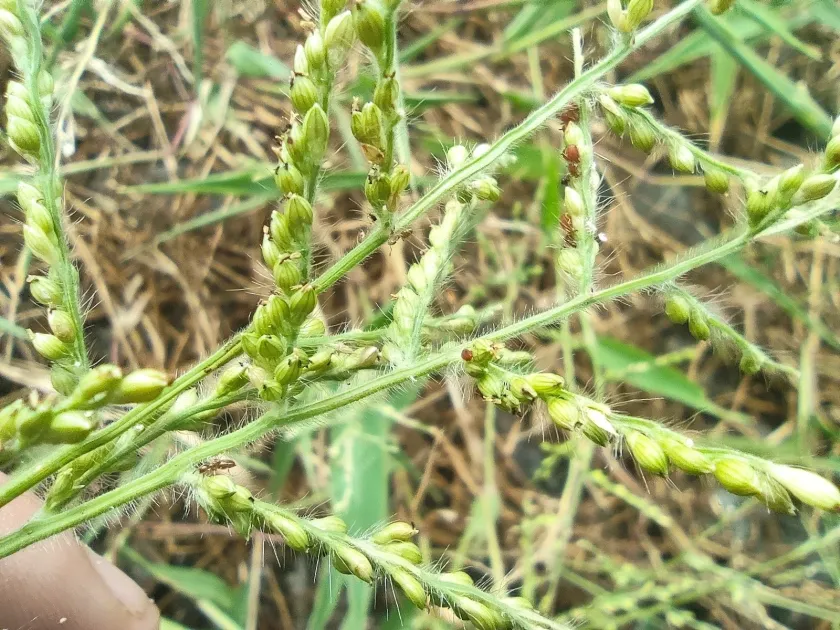
Description
Sowing dates
Browntop millet is typically sown when soil temperatures reach a consistent 15–18 degrees Celsius. As a warm-season crop, it requires stable spring temperatures to germinate effectively and avoid any risk of late-season frost damage.
The seeds should be planted at a depth of 1 to 2 centimeters. Because the seeds are relatively small, it is essential to prepare a firm and well-levelled seedbed to ensure uniform depth and prevent them from being buried too deeply.
Seeding rates vary based on whether the primary goal is forage production or seed harvest. Row spacing generally ranges between 15 and 30 centimeters to provide adequate space for individual plants to tiller effectively and maximize yield.
Post-seeding, rolling the field is highly recommended to improve soil-to-seed contact. This practice is crucial for moisture retention and ensures rapid, uniform emergence, which helps the crop establish dominance over potential weed competitors.
Early-stage weed control is vital as the crop establishes. Once the canopy closes, the fast-growing nature of Browntop millet allows it to naturally shade out many competitive weeds within the field.
Growing requirements
Browntop millet belongs to the Poaceae family and is highly adapted to tropical and subtropical environments. It thrives in regions where warm temperatures allow for an extended growing season and rapid vegetative accumulation.
The crop prefers well-drained, fertile loamy or sandy soils. While it exhibits moderate drought tolerance, consistent moisture levels during the peak growing phase are necessary to achieve high biomass production and quality forage.
Sufficient sunlight is a critical requirement for Browntop millet; it is an obligate sun-loving plant that does not tolerate shade well. Planting should always occur in open, sunlit fields to ensure optimal photosynthetic efficiency.
Nitrogen fertilization significantly enhances vegetative growth, making it a common practice in forage production. However, the crop is sensitive to high soil salinity, which can severely hinder root development and overall plant vigor.
The optimal temperature range for active growth is between 25 and 35 degrees Celsius. If temperatures consistently drop below 10 degrees, the metabolic activity slows down, leading to stagnation in biomass accumulation.
Yield
Browntop millet is widely utilized in agriculture primarily as a forage crop. It is highly valued for grazing livestock, as well as for hay production due to its relatively soft, palatable stalks compared to other millet species.
Total yield is heavily dependent on management intensity, soil fertility, and rainfall. Under optimal irrigation and fertilization, the crop can be harvested multiple times throughout the season, significantly boosting the total annual yield.
Effective pasture management requires a rotational grazing system to allow the crop time to recover. Overgrazing can cause long-term depletion of the root systems, leading to reduced productivity in subsequent cuttings.
The nutritional profile of the plant remains excellent until the onset of the reproductive stage. Foraging animals find the leaves and stems highly digestible, which contributes to weight gain and overall herd health.
Regular maintenance, including strategic nutrient application after each harvest, ensures that the crop maintains high stem density and forage quality throughout the warm summer months.
Main diseases and pests
Fungal diseases, including rusts and various leaf spot pathogens, are the primary health threats for Browntop millet. These issues are most prevalent in humid conditions where dense canopy growth restricts airflow.
Insects such as aphids, armyworms, and other grass-feeding pests can negatively impact the photosynthetic capacity of the plants. Their feeding can cause foliage damage, which lowers the overall biomass quality and yield.
Crop rotation is the most effective preventative measure against these threats. By rotating away from Poaceae family crops, farmers can break the life cycle of specialized pests and soil-borne pathogens that target millet.
Field monitoring is essential for early detection. While pesticide application is an option in severe outbreaks, prioritizing balanced density and healthy soil management is often sufficient to maintain crop resilience.
Ensuring the use of high-quality, certified seeds prevents the introduction of seed-borne pathogens, while maintaining field hygiene reduces the presence of weed hosts that act as disease reservoirs.
Harvesting
The ideal time to harvest Browntop millet for hay or green fodder is just before the peak flowering stage. Harvesting at this point ensures the highest nutrient density, particularly crude protein and sugars.
A cutting height of at least 5–7 centimeters is recommended. This leaves sufficient stubble for the plant to regrow quickly, facilitating the possibility of secondary harvests during the same growing season.
If harvested for hay, rapid drying is critical to prevent spoilage and the development of mold. Properly managed hay maintains its nutritional value and color, which are key indicators of high-quality forage for livestock.
Seed harvesting should be timed carefully to avoid loss due to shattering. The harvest begins when the seed heads shift from green to a golden hue, but before the grains naturally detach from the rachis.
Once harvested, seed material must be thoroughly cleaned and stored in a cool, dry environment to maintain high germination rates for the following planting season.