
Nannochloropsis
Nannochloropsis
Nannochloropsis is a genus of unicellular algae belonging to the class Eustigmatophyceae, which reproduces via asexual cell division rather than seed production.
What the section contains

Nannochloropsis
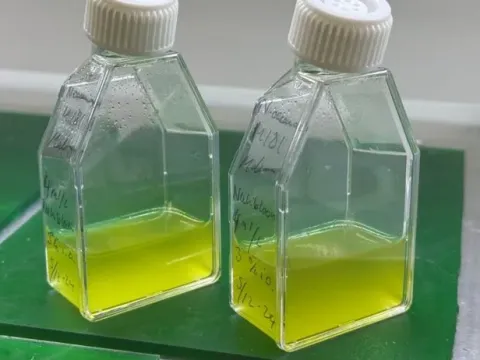
The cultivation process begins with the inoculation of a starter culture into a sterilized medium, typically enriched with essential macro and micronutrients like nitrogen and phosphorus.
Scaling up from the laboratory flask to large-scale reactors requires a gradual increase in volume to ensure the culture maintains a healthy, log-phase growth rate.
The initial density of the inoculum must be carefully calculated to minimize the lag phase and prevent the growth of opportunistic contaminants.
In commercial settings, pure strains are maintained in controlled environments to ensure genetic stability and high-quality biomass output for specific industrial needs.
Successful Nannochloropsis growth requires constant high-intensity light, as the cells depend on photosynthesis for both biomass expansion and lipid synthesis.
Temperatures should be strictly managed between 20°C and 28°C; deviation from this range can lead to physiological stress or total culture collapse.
Salinity levels are typically kept between 15 and 35 ppt, as these conditions mimic natural marine habitats and optimize cellular nutrient uptake.
A steady supply of CO2 is essential to buffer the pH levels within the 7.5 to 8.5 range, ensuring optimal conditions for inorganic carbon assimilation.
Mechanical aeration is vital to provide continuous agitation, preventing cell sedimentation and ensuring consistent exposure to light across the entire culture volume.
Yield metrics for Nannochloropsis are focused on the daily biomass increase per liter or the specific growth rate during the exponential phase.
In high-performance photobioreactors, production can reach approximately 0.5 to 1.0 grams of dry biomass per liter daily under ideal conditions.
Total yield is highly dependent on light penetration depths, which are usually managed by maintaining appropriate cell density in the suspension.
Continuous harvesting methods allow for maximum productivity by replacing harvested portions with fresh, nutrient-rich media on a daily basis.
The lipid profile, specifically the concentration of eicosapentaenoic acid (EPA), is the ultimate indicator of success for high-value aquaculture products.
The primary threat to Nannochloropsis monocultures is the invasion of competing algal species that can outgrow the desired strain in open pond systems.
Bacterial bloom is a significant risk, as it often competes for nutrients and releases secondary metabolites that can be toxic to the microalgae.
Predatory protozoa, such as ciliates and rotifers, can decimate large-scale cultures very quickly if water filtration systems fail.
Viral pathogens pose a constant risk to industrial production, often causing sudden and unexplained culture lysis within a short timeframe.
- Rigorous equipment sterilization protocols.
- Installation of sub-micron air filtration.
- Routine microscopic health assessment.
- Use of batch-to-batch monitoring strategies.
Harvesting is typically performed via centrifugation, which effectively concentrates the algal slurry from the liquid medium for further processing.
For larger, less dense operations, chemical flocculation is often employed as a cost-effective pre-treatment before filtration.
Once harvested, the algal paste must be stabilized immediately—usually via freezing or spray drying—to prevent the oxidation of valuable fatty acids.
The final product is widely used in the aquaculture industry as a high-quality nutritional supplement for rotifers, artemia, and fish larvae.
Proper harvest timing is crucial to maximize the lipid content, as cells harvested during late growth phases often exhibit higher caloric density.