
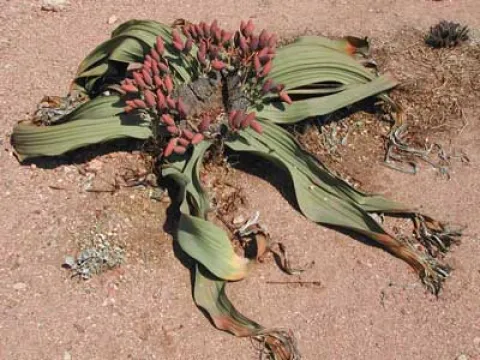
Welwitschia mirabilis
Welwitschia
Propagating Welwitschia from seeds is a sophisticated agricultural process that requires absolute sterility to prevent pre-emergence damping-off. Seeds should be sown in deep containers to accommodate the rapid growth of the taproot.
What the section contains

Welwitschia mirabilis
The optimal germination temperature is between 25 and 30 degrees Celsius. Maintaining this constant thermal environment is essential for breaking seed dormancy and ensuring uniform emergence of the seedlings.
Seedlings exhibit an extremely slow growth rate, a trait common to this gymnosperm. Patience is required, as the transition from the embryonic stage to a stable plant structure can take several months or even years.
Root system protection is paramount; therefore, transplanting should be avoided at all costs. Using biodegradable pots or deep individual containers prevents root disturbance during the initial growth phase.
After the first true leaves emerge, the plant enters a long-term growth cycle where moisture management becomes the most critical aspect of daily agricultural maintenance.
Welwitschia mirabilis belongs to the monotypic family Welwitschiaceae. It is native to the Namib Desert, where it survives in one of the most arid environments on Earth by utilizing specialized stomata to absorb fog.
High light intensity is an absolute requirement for the healthy development of this species. In controlled environments, full-spectrum LED lighting must be used to mimic the intensity of the desert sun throughout the day.
The substrate must provide near-perfect drainage. A mixture consisting primarily of coarse sand, perlite, and a very small fraction of mineral-rich soil is recommended to avoid any water stagnation around the taproot.
Temperature management must include significant diurnal fluctuations. While the plant is heat-tolerant, it requires a drop in temperature at night to regulate its metabolic processes and transpiration rates effectively.
Airflow is critical to the survival of the plant. Constant ventilation helps to prevent localized humidity build-up, which is the leading cause of tissue death in this unique desert dweller.
The primary threat to Welwitschia under cultivation is fungal rot, specifically targeting the root system and the root crown. This is almost always triggered by overwatering or poor drainage in the potting mix.
Pests such as mealybugs often hide within the crevices of the leathery leaves. A strict monitoring schedule is necessary to catch infestations early, as the plant's slow metabolism hinders rapid recovery.
Stagnant air increases the risk of mold growth on the leaf tips. Since the leaves of Welwitschia grow continuously from a basal meristem, any damage to the leaf tissue remains visible for years.
Nitrogen-based fertilizers should be used with extreme caution. Excessive nitrogen forces rapid growth that results in weak, succulent tissues susceptible to bacterial pathogens and structural failure.
To mitigate risks, growers should use only sterilized media and apply irrigation via the sub-irrigation method to ensure the leaves remain dry at all times, preventing fungal spores from settling.