
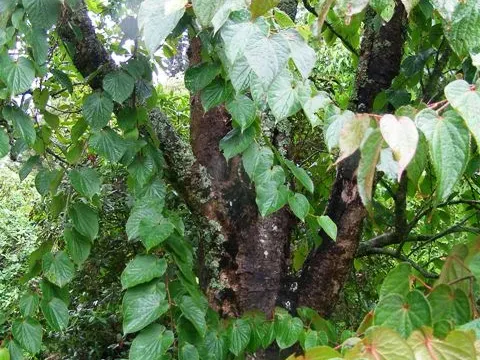
Tetracentron
Tetracentron
Propagation of Tetracentron is primarily achieved through seeds, which require a significant period of stratification to break dormancy and ensure uniform germination.
What the section contains

Tetracentron
Sowing in nurseries should be performed in early spring, once the soil has warmed sufficiently to support the growth of delicate seedlings.
Cuttings represent an alternative method, utilizing semi-hardwood segments treated with specialized rooting hormones to facilitate successful development.
Young plants are highly susceptible to environmental stress and require protection in a nursery environment for the first two to three years of their growth cycle.
Strategic spacing is essential during transplantation, providing the necessary room for the tree to develop its characteristic branching pattern and root architecture.
Tetracentron, a unique member of the Tetracentraceae family, thrives in cool, humid, and mountainous environments similar to its native range in East Asia.
The preferred soil type is a deep, fertile, and well-drained loam with a slightly acidic to neutral pH, ensuring the root system avoids waterlogging.
The culture requires protection from strong winds and intense, direct sunlight, preferring a sheltered site with ample ambient moisture in the atmosphere.
Agricultural management involves consistent application of organic amendments and mulch to maintain soil temperature stability and consistent humidity levels.
Due to its relic status, climate adaptability is limited, necessitating careful site selection to mimic the ecological niche of high-altitude forest margins.
Commercial utilization of Tetracentron is minimal due to its scarcity, with the primary focus directed toward conservation and botanical study.
The wood possesses a fine-grained texture and attractive aesthetics, offering potential value for high-end cabinetry and decorative woodworking industries.
As a primitive flowering plant, its value is significantly higher in the fields of evolutionary botany and dendrological collection management.
The tree can serve as a majestic specimen in large park landscapes, provided that the regional climate meets the specific requirements for long-term health.
Future potential lies in sustainable forest restoration efforts, where the species can be integrated into high-diversity planting schemes in suitable latitudes.
Root rot pathogens pose the most significant threat to the plant, particularly when grown in heavy soils with poor drainage capacity.
Leaf spot fungi may emerge during periods of stagnant air and excessive moisture, necessitating improvements in canopy ventilation and air circulation.
Rodent damage to the bark of juvenile trees is a frequent occurrence during winter, requiring physical barriers to protect the main trunk and root collar.
Vulnerability to mechanical damage makes the tree sensitive to careless site maintenance, which can introduce decay-causing microorganisms into the wood.
Regular monitoring for pests and diseases is crucial, as the species does not readily recover from severe infestations once they have been established.