
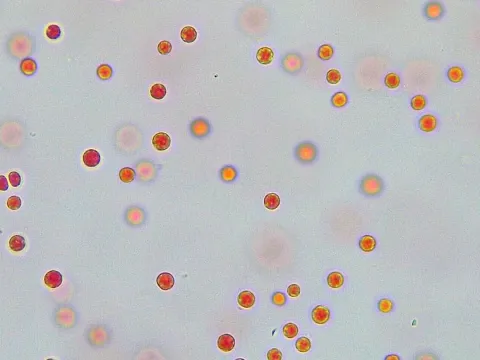
Porphyridium
Porphyridium
In industrial settings, Porphyridium is not sown in the traditional agronomic sense, as it is a unicellular red alga. Cultivation begins with the preparation of a sterile inoculum in a controlled laboratory environment.
What the section contains

Porphyridium
The transfer of the inoculum into the main production reactors occurs when the culture reaches the active logarithmic growth phase. It is essential to maintain optimal cell density to ensure efficient light utilization.
The "sowing" process involves adjusting the nutrient medium to the required concentration of micro- and macronutrients. Maintaining equipment sterility is critical for stable reproduction to prevent contamination by other strains.
The frequency of culture renewal depends on the system used, such as open ponds or closed photobioreactors. In closed systems, cultivation can be continuous if biomass is harvested regularly.
Monitoring of the inoculum's status is conducted daily using light microscopy and optical density measurements. Any deviation in the medium composition during the sowing phase can lead to strain degradation.
Porphyridium belongs to the Porphyridiaceae family and requires specific environmental conditions for photosynthesis and exopolysaccharide biosynthesis. The optimal temperature range for growth is between 15 and 25 degrees Celsius.
For metabolic activity, the microalga requires access to intense sunlight or artificial light with a specific spectral composition. A deficit of light drastically reduces productivity and pigment synthesis.
The medium must be enriched with nitrogen, phosphorus, iron, and other micronutrients in precise proportions. The pH level of the suspension must be maintained in an alkaline range, typical for marine algae.
Aeration or agitation of the medium is a vital factor that ensures even access to carbon dioxide and prevents cell sedimentation to the bottom of the reactor. Lack of mixing leads to culture decline.
Salinity is a key parameter for maintaining the integrity of the Porphyridium cell wall. The culture exhibits high adaptability to salinity changes, but extreme fluctuations cause osmotic stress.
Porphyridium yield is measured by biomass output per liter of reactor volume or square meter of area in open cultivation. Productivity depends directly on the intensity of photosynthesis and cell division rates.
The use of closed photobioreactors allows for significantly higher biomass yields compared to open ponds. This is due to better control over gas composition and temperature.
Average productivity can range from 0.5 to 2 grams of dry biomass per liter of suspension per day. These figures are indicative and depend on the specific strain of Porphyridium being cultivated.
An additional harvest product is the sulfated exopolysaccharide released by cells into the culture medium. Harvesting this valuable substance requires centrifugation and precipitation techniques.
The final yield depends on the cultivation cycle: the longer the exponential growth phase, the higher the concentration of target compounds in the biomass. Once maximum density is reached, the plateau phase begins, requiring immediate harvest.
The main threat to Porphyridium is contamination by other microalgae, bacteria, or protozoa. Contaminated cultures often require total disposal due to the target strain's lack of competitiveness.
Infections caused by algal viruses can lead to the sudden lysis of cell populations in industrial installations. This is a rare but critical event that requires strict quarantine control.
Chemical stress due to the accumulation of metabolic products or pH changes can suppress growth. Disruptions in nutrient balance often provoke the growth of unwanted microorganisms in the environment.
Insufficient mixing intensity leads to local stagnant zones where anaerobic conditions occur, which are lethal to Porphyridium. In such zones, putrefactive bacteria multiply rapidly.
Biotic factors, such as grazing by zooplankton, pose a danger in open cultivation systems. Protection includes the use of water filtration systems and circuit sealing.
Harvesting Porphyridium begins with the concentration of the suspension, most often performed by centrifugation. This allows for the separation of algal cells from the culture liquid.
After centrifugation, the resulting paste is dried, usually via spray drying or lyophilization, to preserve the biological value of the product. Temperature control during drying is strictly limited.
To extract exopolysaccharides, precipitation using ethanol or other organic solvents from the filtered culture liquid is employed. This process requires a high level of chemical purification.
The final biomass is used in the cosmetic, pharmaceutical, and food industries. Purified polysaccharides are widely used as thickeners and stabilizers in high-tech products.
The entire harvesting cycle must be completed as quickly as possible to avoid enzymatic degradation of valuable components within the biomass. Rapid cooling of the collected material is essential to ensure quality.