
Short-leaf veldt grass
Ehrharta brevifolia
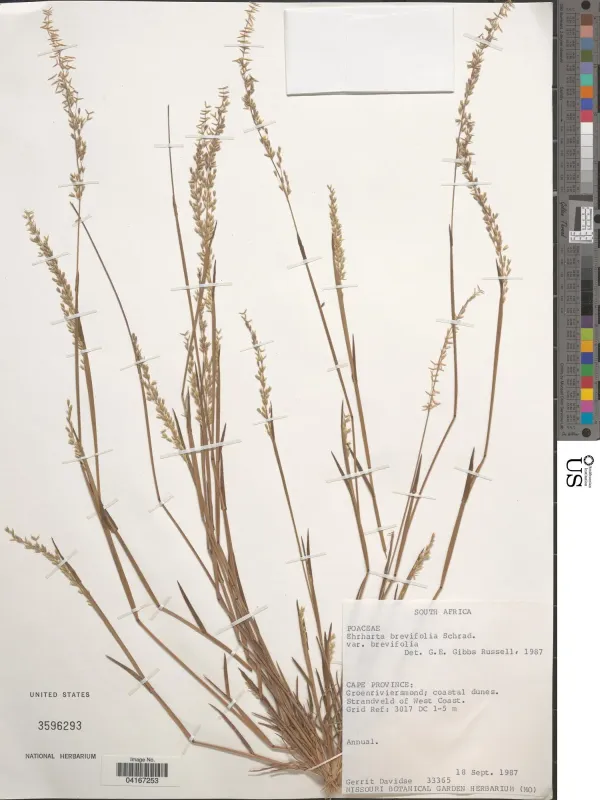
Description
Sowing dates
Ehrharta brevifolia is a perennial grass that is traditionally propagated by seeds. The optimal sowing time coincides with the start of the rainy season to ensure sufficient moisture for successful germination.
The seeds of this crop have high germination rates but require minimal soil covering to ensure good contact with the substrate. When cultivated in arid regions, sowing should be performed in well-prepared, weed-free soil.
Adherence to recommended seeding rates is a critical factor for success and should be adapted to the specific soil types of the region. Even seed distribution across the field promotes the formation of a dense sward.
In its natural habitat, the plant tends to regenerate naturally through self-seeding, which helps maintain stable population density in pastures. When artificially sown, rolling the soil after planting is recommended to fix the seeds.
The germination process requires stable soil temperatures; therefore, it is advisable to avoid sowing during periods of extreme night frost or anomalous heat that could damage the seedlings.
Growing requirements
The crop belongs to the Poaceae family and shows high adaptability to sandy and sandy loam soils. It is capable of surviving in nutrient-poor environments.
Short-leaf veldt grass prefers open, well-lit areas with moderate rainfall, typical of Mediterranean or arid climates. It is highly resilient to short-term drought periods.
The plant does not tolerate waterlogged soils or prolonged water stagnation; therefore, fields with excellent drainage are prioritized for the cultivation of this crop.
A vital requirement for full growth is access to sufficient sunlight, as shading leads to stunted development and a decrease in vegetative biomass.
The optimal pH level for growth ranges from slightly acidic to neutral, making the plant versatile for many regions with limited resources.
Yield
The productivity of Ehrharta brevifolia depends directly on the intensity of rainfall during the growing season. It provides stable green mass production during the autumn and winter months.
Using the plant as pasture forage allows for the rational utilization of land that is otherwise unsuitable for other agricultural crops.
Under controlled grazing, the crop demonstrates excellent capacity for rapid regrowth after being grazed, which increases the overall productivity of forage lands.
Maximum nutritional value of the green mass is observed before the heading stage. Strict adherence to grazing schedules is recommended to maintain the longevity of the stand.
Average yields in favorable years allow for the support of livestock in arid territories where alternative forage plants cannot survive.
Main diseases and pests
Common diseases for this grass include fungal infections, such as rust, which develop under conditions of excessive humidity and crowded planting.
Pests typical for most wild grasses may include locusts and various leaf-eating insects, which can cause significant damage during mass outbreaks.
Root rot may occur under systematic soil waterlogging, making the correct selection of a well-drained site critical for protecting the crop.
Weeds also negatively affect yield; in the early growth stages, competition from weeds can suppress the development of veldt grass seedlings.
Disease prevention consists of maintaining proper grazing regimes and avoiding excessive soil compaction by livestock hooves, which improves root system aeration.
Harvesting
Harvesting is most commonly carried out through rotational livestock grazing, which is the most economically efficient way to utilize this plant.
If hay production is required, harvesting should be performed during the flowering phase, when the nutrient and protein content in the stems is at its optimal level.
Mowing should be performed at a sufficient height to avoid damaging the growth points, ensuring subsequent vegetative recovery of the plant.
For seed production, harvesting is performed after the panicles have fully matured, when the seeds are dry and easily detached, to prevent shedding in the field.
Storing seed material requires a cool, dry place to ensure viability for planting in the following season.