
Andropogon fragilis
Andropogon fragilis
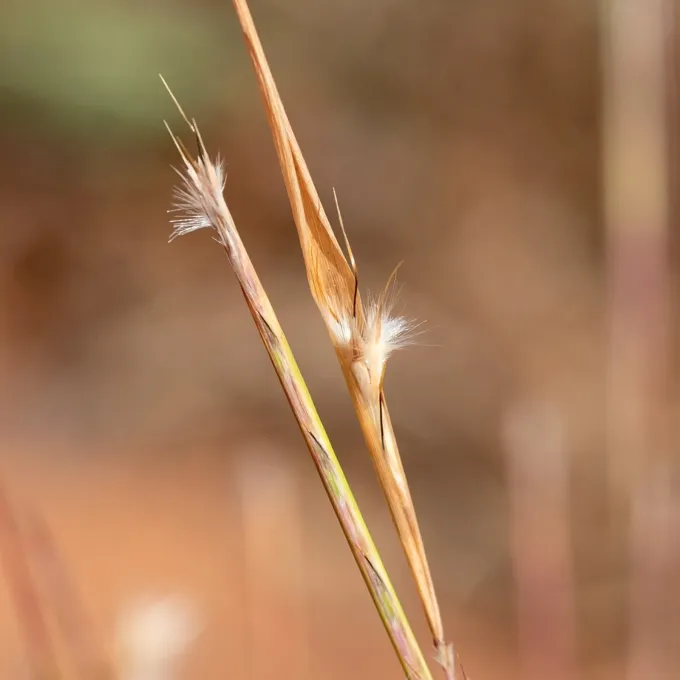
Description
Sowing dates
Sowing of Andropogon fragilis is best executed during the spring, ensuring that soil temperatures have risen sufficiently to trigger rapid germination of the seeds.
The seeding depth should be kept shallow, typically between 1 and 2 centimeters, to prevent excessive energy expenditure by the seedling before emergence.
In the first year, establishment is critical. Minimizing competition from weeds is essential, as the young plants grow slowly while they focus on building their root biomass.
Proper spacing is recommended to ensure that each plant has sufficient access to nutrients and sunlight, which facilitates faster development of the sod layer.
Rolling the field post-sowing is a recommended practice to improve soil-to-seed contact, especially in drier environments where moisture loss at the soil surface is a major risk.
Growing requirements
Andropogon fragilis is a perennial grass species belonging to the Poaceae family. It is known for its adaptation to open landscapes and its ability to withstand significant environmental stress.
The plant thrives in well-drained soils and is particularly well-suited for areas with arid or semi-arid climates. Its root system is exceptionally robust, allowing it to penetrate deep soil horizons for moisture.
Climatically, it prefers warm temperatures and receives sufficient solar radiation. While it shows good drought resistance, its productivity peaks in environments where rainfall is distributed across the growing season.
Regarding soil requirements, it is flexible, performing adequately on sandy and loam soils provided that there is no waterlogging. Poor drainage is detrimental to the survival of this species.
The plant exhibits high biological plasticity, adapting its growth habit based on soil nutrient availability and local competitive pressures from surrounding vegetation.
Yield
The primary agricultural use of Andropogon fragilis is as forage for livestock. It provides a reliable source of green mass, especially in managed pasture systems.
Yields are maximized when the grass is harvested or grazed before the reproductive stage. As the plant enters the flowering phase, nutritional quality decreases due to increased lignification.
The forage value is considered good for cattle and sheep, provided that the grazing rotation is strictly managed to allow for necessary recovery periods.
Integrating this grass into forage systems can help maintain consistent biomass production in areas where other more demanding grass species might fail.
Beyond feed, its ability to bind soil with its extensive root network makes it a valuable component in land restoration projects and erosion control programs.
Main diseases and pests
The health of Andropogon fragilis stands can be compromised by various rust fungi, which are particularly prevalent in seasons characterized by high humidity and poor air circulation.
Insect pests such as grass flies and aphids may impact the growth of young shoots, potentially reducing the overall vigour of the stand if infestations are severe.
Proper management of the stocking density in pastures is crucial. Overgrazing can weaken the plants, leaving them more susceptible to pathogens and weed invasion.
Monitoring for signs of disease during the early stages of the growing season is a key component of effective pest management and crop health maintenance.
Preventive measures, including adequate nutrient management and avoiding excessively dense monoculture stands, remain the most effective strategies for long-term health.