
Needle-leaf ludwigia
Ludwigia arcuata
Description
Growing requirements
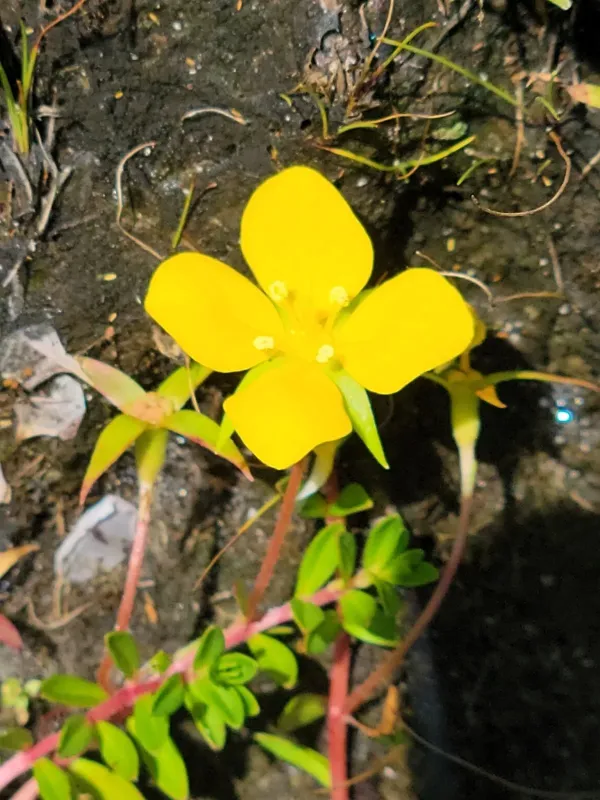
Needle-leaf ludwigia (Ludwigia arcuata) is an amphibious herbaceous perennial belonging to the Onagraceae family. It is native to the southeastern regions of the United States, typically found in marshes, swamps, and along the banks of slow-moving streams.
The plant features distinct needle-like, curved leaves arranged in opposite pairs along a thin, branching stem. Under high light intensity and proper nutrient balance, the foliage transitions from green to vibrant shades of red and gold.
Successful cultivation requires high-intensity lighting, which is necessary to maintain the plant’s compact growth habit and its signature coloration that defines its ornamental value.
Optimal growth conditions involve slightly acidic to neutral water (pH 6.0–7.5) with low to moderate carbonate hardness and the regular injection of CO2 to support rapid biomass production.
The root system benefits from a nutrient-dense substrate rich in iron and trace elements, which promotes robust stem development and facilitates the propagation of lateral shoots.
Main diseases and pests
The primary concern during cultivation is the accumulation of epiphytic algae on the leaf surfaces, which restricts gas exchange and significantly inhibits the plant’s photosynthetic efficiency.
Nutrient deficiencies, particularly iron or nitrates, often manifest as chlorosis or stunted internodes, causing the plant to lose its attractive form and vibrant color.
Root rot is a common issue when the substrate becomes compacted and anaerobic, leading to the death of root hairs and subsequent collapse of the stems.
Sensitive to environmental fluctuations, the plant may exhibit leaf drop when there are sudden changes in water chemistry, especially regarding sudden shifts in alkalinity or temperature.
Herbivory from certain aquatic snails or overly aggressive fish species can damage the succulent growing tips, resulting in unsightly branching and irregular growth patterns.