
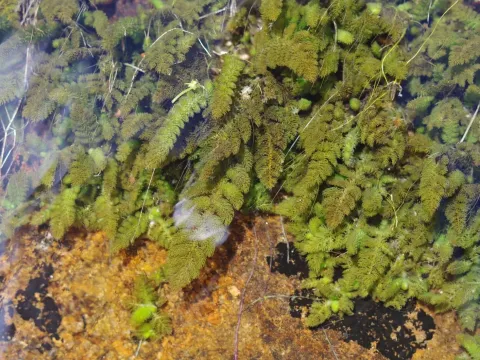
Hydrostachys
Hydrostachys
Hydrostachys is a unique genus of aquatic perennials classified within the family Hydrostachyaceae. These plants are true rheophytes, meaning they are evolutionarily adapted to survive and thrive in fast-flowing tropical river currents and waterfall zones.
What the section contains

Hydrostachys
The natural range of Hydrostachys is concentrated in the tropical regions of Africa and Madagascar. These plants require extremely specific habitats, typically attaching themselves to rocky substrates in high-oxygen environments where fast-moving water prevents silt accumulation.
Botanically, these plants exhibit a fascinating morphology, possessing a thalloid structure rather than traditional roots for attachment. Their leaves are often highly dissected or compound, which provides structural integrity and minimizes drag against the powerful force of mountain streams.
The environmental requirements for these plants are strict. They demand clean, oligotrophic, well-oxygenated water. They are highly specialized, and replicating such conditions in an artificial or agricultural setting is currently not feasible for commercial production.
While not a traditional agricultural crop, the genus is of significant interest to botanical science and conservation biology. Understanding their life cycle helps in managing river ecosystems, as these plants often serve as indicators of water quality and habitat integrity.
The primary threat to Hydrostachys species is the alteration of river systems. The construction of dams, water diversion projects, and changes in seasonal flooding patterns significantly disrupt their ability to survive, as they rely on specific water velocities.
Agricultural runoff, including excess nutrients and pesticides, poses a grave danger to these sensitive plants. Increased nutrient levels can lead to algal blooms, which choke the riverbed and prevent Hydrostachys from attaching to its rocky substrate.
Habitat loss due to siltation is another critical threat. When river flow is reduced, sediment buries the rocky areas required for attachment, causing the plants to lose their footing and ultimately leading to the decline of entire populations.
Pests that affect Hydrostachys are primarily endemic aquatic invertebrates. Although these organisms occasionally consume leaf tissues, the damage is usually localized and does not pose a systemic threat to the overall population health.
Pathogenic threats are often linked to stagnating water conditions. When the natural flow of a river is obstructed, the plants become susceptible to fungal and bacterial infections, which rapidly deteriorate their delicate tissues and lead to plant death.