
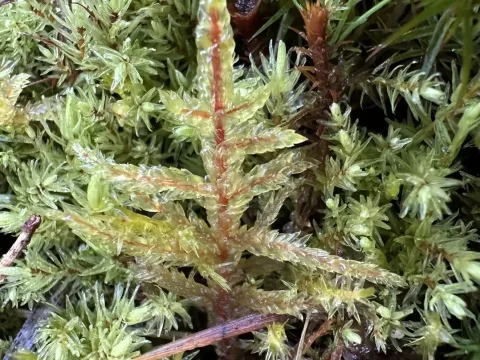
Pleurozium schreberi
Pleurozium
Pleurozium schreberi, commonly known as red-stemmed feather moss, is a significant bryophyte within the Hylocomiaceae family. It is widely distributed across boreal and temperate forests in the Northern Hemisphere, serving as a primary component of the forest floor.
What the section contains

Pleurozium schreberi
This moss thrives in shaded, moderately moist environments, typical of coniferous forests. It exhibits a high tolerance for acidic soil conditions and low nutrient availability, allowing it to dominate areas where vascular plants struggle to establish.
The plant prefers stable microclimatic conditions, specifically avoiding direct sunlight and excessive drying. Its physical structure consists of a prostrate stem with reddish coloration and feathery, pinnate branches that capture moisture efficiently.
Cultural practices do not exist for this species as it is not a commercial crop; rather, it is managed through forest conservation efforts. It acts as an indicator species, reflecting the overall health and environmental stability of the forest ecosystem.
Pleurozium requires minimal nitrogen levels, making it highly sensitive to atmospheric pollutants. Excessive nitrogen deposition can lead to the displacement of this moss by more nutrient-demanding vegetation, disrupting the forest floor's equilibrium.
The productivity of Pleurozium is defined by its vertical growth rate and surface coverage density. In optimal conditions, it forms deep, plush mats that contribute significantly to the carbon storage and organic matter profile of the soil.
Annual growth rates for this species typically range between 1 to 3 centimeters. While this may seem slow, it is sufficient to maintain a continuous, protective layer over the forest soil, preventing erosion and regulating moisture levels.
Industrial harvest is generally discouraged or prohibited, given the slow regeneration time and the critical ecological services the moss provides. Its value lies in its role as an ecosystem engineer rather than as a source of raw material.
Studies indicate that under consistent forest canopy cover, this species can achieve high levels of dominance, covering vast tracts of land. This density is a positive indicator of an intact, well-functioning woodland habitat.
Research into potential pharmaceutical applications continues, focusing on the antimicrobial properties found in its biomass. However, sustainable harvesting techniques are essential to avoid negative impacts on the forest floor biodiversity.
The most severe threat to Pleurozium populations is commercial logging, which alters microclimatic conditions by removing canopy cover. This change in light and humidity levels often leads to rapid desiccation and mortality of the moss colonies.
Atmospheric pollution, particularly acid rain and nitrogen deposition, represents a major stressor. Because mosses lack a cuticle to protect their tissues, they absorb pollutants directly, which inhibits their photosynthetic capacity and growth.
Pathogenic fungi can occasionally threaten the health of moss mats during periods of extreme warmth and humidity, though these outbreaks are usually managed by the surrounding natural biotic community.
Herbivory by small invertebrates, such as mites and nematodes, is a constant factor in the moss's life cycle. While these organisms consume parts of the plant, they rarely pose a threat to the survival of healthy, established mats.
Drought-induced climate change is an emerging danger. Extended periods without precipitation force the moss into a state of dormancy, significantly reducing its reproductive success and its ability to recover from physical damage.