
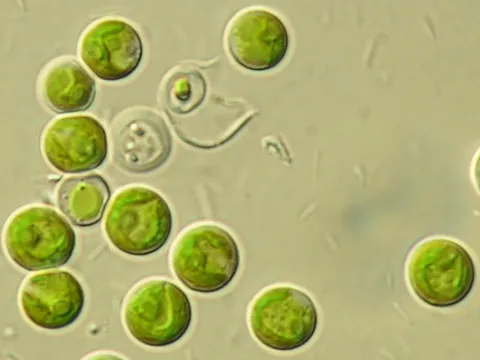
Chlorococcum
Chlorococcum
Chlorococcum is a genus of green microalgae where the term sowing refers to the inoculation process. Pure strains are introduced into sterilized liquid or gel-based culture media under strictly controlled laboratory or industrial conditions to start the growth cycle.
What the section contains

Chlorococcum
The timing of inoculation is determined by the readiness of the photobioreactor system and the availability of optimized nutrient media. Because these organisms require consistent light, production cycles can be maintained year-round if proper environmental controls are in place.
Seed material preparation requires high levels of aseptic technique to ensure the dominance of the selected Chlorococcum strain. A sufficient initial cell density is crucial for a rapid transition into the exponential growth phase.
In industrial settings, the inoculation process is often automated, integrating with the fluid dynamics of the bioreactor. This ensures that every cycle starts with a viable and vigorous population of cells, minimizing the lag period before mass growth.
Effective colonization depends on the genetic purity of the strain. Regular renewal of the stock culture prevents genetic drift, ensuring that the biomass produced remains consistent in its chemical profile and productivity levels.
Belonging to the family Chlorococcaceae, these algae are highly adaptable to various controlled environments. They require a balanced nutrient solution containing essential macro and microelements, including nitrogen, phosphorus, and potassium.
Temperature management is vital, with an optimal range between 20°C and 28°C. Fluctuations outside this window can disrupt metabolic pathways, leading to inhibited cell division and reduced biomass yield.
Light intensity and spectral quality are primary factors for growth. Chlorococcum utilizes photosynthetic activity to convert carbon dioxide into chemical energy. Sufficient artificial lighting or optimized solar exposure is necessary to maximize cellular synthesis.
The pH level must be strictly monitored and maintained in the neutral to slightly alkaline range. Carbon dioxide supply is essential, acting as both an inorganic carbon source and a natural regulator of the solution’s acidity.
Adequate aeration and agitation are non-negotiable requirements. These processes prevent cell sedimentation at the bottom of the reactor, ensure uniform light exposure, and facilitate efficient gas exchange between the medium and the culture.
Yield metrics for Chlorococcum are typically expressed as grams of dry biomass per square meter or liter per day. Under high-intensity cultivation, this microalga exhibits impressive growth rates, often surpassing traditional land crops.
The conversion efficiency of light energy into biomass is a key performance indicator. High-quality yield is characterized by a nutrient-dense profile rich in lipids, proteins, and vitamins, which are vital for feed and supplement industries.
Harvest timing is critical and is usually dictated by the optical density of the suspension. Producers aim to harvest when cells reach the peak of their metabolic activity, just before the culture reaches the stationary phase.
Data-driven yield management involves constant monitoring of cell concentrations. Using spectrophotometric analysis allows operators to predict the ideal harvest time, ensuring both quantity and quality of the final product.
Economic viability relies on the balance between input costs, such as energy for lighting and CO2 supply, and the total yield produced. Optimization of these factors is the core objective of modern microalgae farming.
The most significant threats to Chlorococcum cultures are biological contaminants, including protozoa, fungi, and competing algal species. These organisms can outcompete or graze on the algae, leading to rapid population collapses.
Viral infections, while less documented than bacterial threats, can cause massive cell lysis. Maintaining a sterile production environment and implementing rigorous filtration of input air and water are primary defense mechanisms.
Photoinhibition is a physiological threat caused by excessive light exposure. It damages the photosynthetic apparatus, leading to pigment degradation and loss of reproductive potential, effectively halting the growth process.
The accumulation of metabolic waste products in the medium can create a toxic environment for the cells. If not managed through filtration or media exchange, these products inhibit growth and promote culture aging.
Prevention relies on comprehensive hygiene protocols, including ultraviolet sterilization of all supply streams. Constant monitoring allows for early detection of potential threats, enabling rapid corrective actions.
Harvesting is primarily achieved through centrifugal separation or filtration systems. The resulting dense algal paste contains a high percentage of moisture and requires immediate processing to prevent spoilage.
Post-harvest stabilization involves drying the biomass, typically using spray-drying or vacuum-drying methods. These technologies are designed to preserve the delicate nutritional components of the algae while creating a shelf-stable powder.
Quality control is mandatory for the dried product. Testing ensures the absence of heavy metals, microbial pathogens, and other contaminants, verifying that the batch meets safety standards for intended applications.
Flocculation agents are sometimes used to aid in harvesting. These substances bind cells together, allowing for easier extraction without the high energy consumption of industrial centrifuges, although they require careful washing.
After processing, the final product is packaged and stored in controlled conditions. Efficient harvest management ensures that the cycle can be immediately restarted, maintaining continuous production and output levels.