
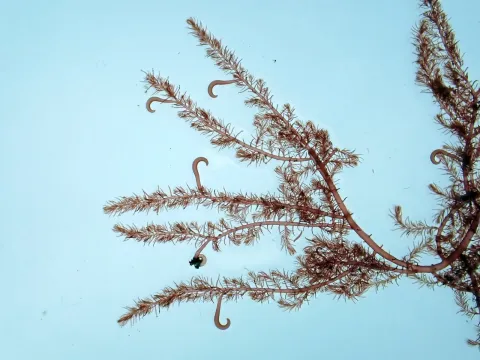
Bonnemaisonia
Bonnemaisonia
Bonnemaisonia is a genus of red algae belonging to the Bonnemaisoniaceae family. As a marine crop, it is not planted in soil but rather cultivated in seawater using suspended ropes or net substrates that mimic natural rocky habitats.
What the section contains

Bonnemaisonia
The life cycle of the plant involves alternating generations, which requires specialized nursery environments to manage the transition between the tetrasporophyte and gametophyte stages. Successful cultivation depends on mastering these biological requirements.
In industrial aquaculture, vegetative propagation is the most efficient method for biomass expansion. Cuttings are attached to long lines that are deployed in coastal waters, allowing for rapid colonization and growth of the thallus.
Water clarity and light penetration are essential for photosynthesis, which drives the development of the algae. Farm sites are carefully selected in areas with optimal depth and minimal turbidity to maximize growth rates.
Cultivation cycles are timed to align with seasonal marine conditions. Farmers typically initiate planting in early spring to leverage the period of optimal temperature and nutrient availability in the water column.
Bonnemaisonia has strict environmental requirements, typically thriving in temperatures between 10 and 18 degrees Celsius. Stability in thermal conditions is crucial to prevent metabolic stress and ensure consistent biomass production.
The plant requires constant water movement to maintain a steady flow of nutrients such as nitrogen and phosphorus. This dynamic environment supports the development of healthy, vibrant tissue rich in valuable secondary metabolites.
Substrates for attachment, such as roughened nylon ropes or synthetic nets, are essential for the physical support of the algae. The culture must be deployed in areas with stable salinity levels to avoid osmotic damage to the cells.
pH levels must remain within a slightly alkaline range, common for healthy marine ecosystems. Any significant deviation can impede growth and make the crop more susceptible to environmental stressors.
Light management is a critical aspect of farming this species. While they need light for growth, excessive intensity can lead to photoinhibition, necessitating depth adjustments throughout the growing season.
The yield of Bonnemaisonia is determined by planting density and the effective utilization of the water column. Advanced aquaculture operations optimize space to achieve high tonnage of dried seaweed per hectare.
High daily growth rates permit multiple harvests per season under favorable marine conditions. Strategic pruning and thinning of the thallus encourage branching, which in turn leads to a higher overall biomass yield.
Mechanical harvesting systems have been developed to increase the efficiency of collecting the crop. Care is taken to minimize physical damage to the plant during collection, ensuring high-quality final product consistency.
The extraction of halo-metabolites is a major goal for producers, and yield is often calculated based on the chemical content of the dried seaweed. Timing the harvest based on metabolite concentration is vital for maximizing market value.
Integrated multi-trophic aquaculture (IMTA) is frequently employed, where these algae are grown alongside shellfish, resulting in a cleaner marine environment and improved economic output for the farmers.
Epiphytic microalgae pose the greatest threat to Bonnemaisonia crops by competing for light and nutrients. Severe infestations can rapidly degrade the quality of the harvest and necessitate early mitigation strategies.
Bacterial pathogens, particularly those that thrive in warm or stagnant water, can cause tissue decay. Maintaining proper flow and managing stock density are key practices in preventing disease outbreaks on the farm.
Marine herbivores, such as sea urchins and certain crustacean species, can decimate a crop if left unchecked. Protective mesh and regular site inspections are required to defend the seaweed from these grazers.
Pollution from agricultural or industrial runoff represents a significant risk, as algae bioaccumulate heavy metals. Farms must be located in areas with strictly regulated water quality to remain viable.
Severe weather and storm surges can physically strip the seaweed from its mooring points. Durable, high-tension anchoring systems are utilized to mitigate the risk of loss during extreme sea conditions.
Harvesting begins when the thallus reaches the target length and exhibits the desired concentration of chemical compounds. Precise timing is essential to obtain a high-quality product for the pharmacological market.
Immediately after being lifted from the water, the biomass is cleaned of debris and foreign organisms. Efficient processing at the site is crucial to prevent the degradation of bioactive components before drying.
The drying process is conducted in a climate-controlled environment with low heat, as the active compounds are often heat-sensitive. Careful handling ensures that the potency of the raw material is maintained.
Finished product is vacuum-sealed to prevent oxidation and moisture absorption. This professional packaging allows for long-term storage and easier transport to processing facilities for extraction.
All batches undergo rigorous laboratory testing to ensure purity and compliance with industry standards. Only material meeting these specifications is sold for medicinal, food, or research purposes.