
Bonnemaisonia hamifera
Bonnemaisonia hamifera
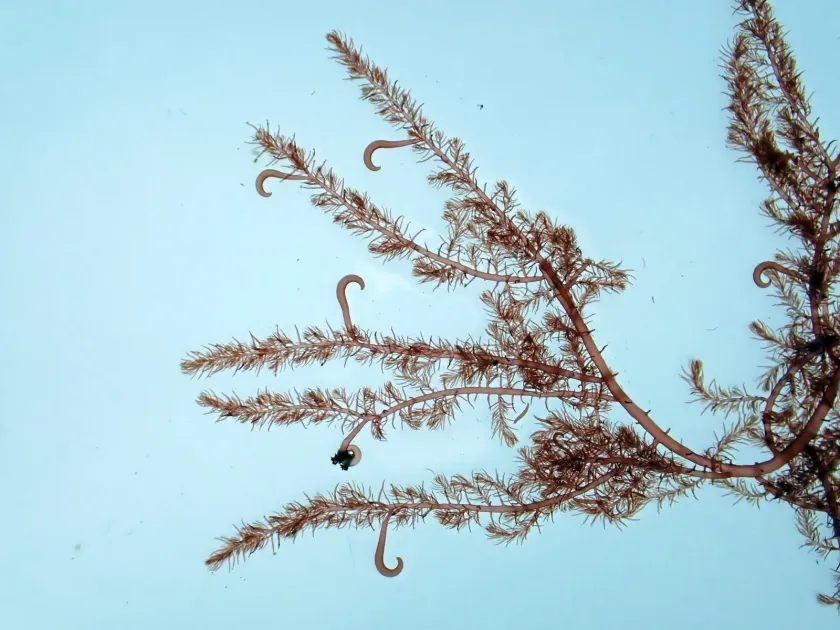
Description
Sowing dates
The life cycle of Bonnemaisonia hamifera involves a complex heteromorphic alternation of generations, which is vital for managing the cultivation schedule.
In natural habitats, gametophytes grow primarily during the summer, when the water temperature is optimal for rapid vegetative expansion of the thalli.
For industrial farming, inoculum is typically obtained through vegetative propagation using thallus fragments, which demonstrate excellent regenerative capacity.
Inoculation of cultivation substrates usually takes place in early spring to ensure the fragments attach securely before the peak season of epiphytic competition.
Maintaining an appropriate density of planting material is crucial to avoid overcrowding, which limits nutrient uptake and light penetration throughout the crop.
Growing requirements
Bonnemaisonia hamifera is a red alga belonging to the Bonnemaisoniaceae family, well-adapted to temperate marine environments.
The culture thrives in areas with moderate water flow, which ensures a steady supply of essential nutrients for sustained vegetative growth.
Salinity levels ranging from 25 to 35 parts per thousand are considered optimal for maintaining the physiological integrity of the thalli.
Temperature management is critical, with a range of 8 to 18 degrees Celsius being ideal for biomass accumulation while avoiding heat-induced tissue degradation.
Light availability is a primary factor; therefore, the depth of substrate placement must be adjusted based on water transparency to optimize photosynthetic rates.
Yield
The yield of Bonnemaisonia hamifera is heavily dependent on the concentration of dissolved nitrogen and phosphorus in the surrounding water column.
Integrating this crop into Multi-Trophic Aquaculture (IMTA) systems can significantly improve biomass output by utilizing waste products from fish or shellfish farms.
Production volumes are limited by seasonal conditions, necessitating strategic timing of the farming cycle to maximize output within favorable temperature windows.
Field data indicates that a planting density of 2–3 kg per square meter of substrate is efficient for achieving consistent commercial profitability.
The synthesis of specific chemical compounds within the algae is light-dependent, requiring careful management of exposure levels to ensure a high-quality final product.
Main diseases and pests
The primary biological threat to the crop is the overgrowth of epiphytic microalgae, which compete for space, light, and essential nutrients.
Bacterial biofilms on the thallus surface pose a significant risk, particularly under stagnant conditions, leading to tissue decay and potential crop loss.
Small marine crustaceans, such as amphipods, are common pests that graze on the algal tissue, causing structural damage to the plants.
Environmental stressors, especially severe storms, represent a physical risk that can dislodge the algae from their substrates and cause total crop failure.
- Epiphytic microalgae
- Bacterial tissue infections
- Amphipod grazing
- Mechanical storm damage
- Nutrient depletion
Harvesting
Harvesting involves the mechanical cutting of the thalli from the cultivation ropes or nets once the biomass has reached the desired maturity level.
Timing the harvest is critical; premature collection results in low yields, while delaying harvest can lead to increased brittleness and quality decline.
Following harvest, the raw biomass must be immediately cleaned to remove marine debris and associated organisms that might contaminate the product.
Proper post-harvest handling, such as rapid drying or freezing, is essential to prevent enzymatic degradation and preserve the target chemical components.
Logistical efficiency is key, ensuring the transport of the harvested seaweed to processing facilities occurs within the shortest possible timeframe.