
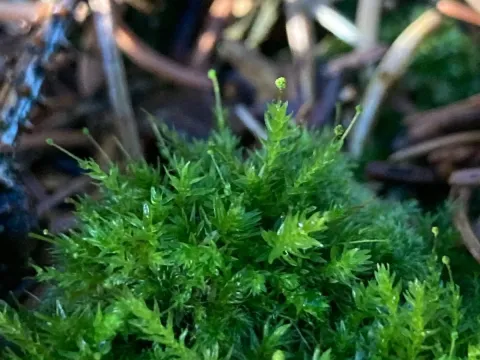
Aulacomnium
Aulacomnium
Aulacomnium is a genus of perennial leafy mosses belonging to the Aulacomniaceae family. These plants are known for forming dense, cushion-like mats or carpets in their natural habitats, which include damp, shaded environments throughout the Northern Hemisphere.
What the section contains

Aulacomnium
The distribution of Aulacomnium encompasses diverse ecological zones, ranging from temperate forests to arctic tundras. They are most commonly found in boggy sites, along streams, and on decaying organic matter, where they contribute to soil moisture retention.
Success for this moss requires a consistently humid environment. It thrives on acidic to slightly acidic substrates that are rich in organic nutrients, making it a key component of fen and peat bog plant communities globally.
Botanically, these plants are highly adapted to low-light conditions. Their ability to survive under dense forest canopies is facilitated by their efficient photosynthetic structures, which operate well in the diffuse light characteristic of woodland interiors.
Vegetative reproduction is a hallmark of the genus, frequently achieved through specialized propagules known as gemmae. These structures allow for rapid expansion across favorable landscapes, enabling the moss to maintain stable populations over time.
The primary threat to Aulacomnium populations is the drainage of wetlands and marshes for land development. The loss of stable, high-moisture ground leads to rapid desiccation and the eventual disappearance of moss colonies from their natural sites.
Atmospheric pollution and acid rain pose significant risks to the physiological health of the plants. As bryophytes lack a root system and absorb nutrients and moisture directly from the air and precipitation, they are highly sensitive to pollutants.
Physical disturbance is a major concern, as the fragile structure of Aulacomnium mats is easily destroyed by trampling or heavy machinery. Once the mat is broken, recovery is slow and often results in erosion of the underlying organic substrate.
Competitive displacement by vascular plants remains a constant pressure in changing environments. As areas dry out or become enriched with nitrogen, grasses and shrubs often outcompete the slower-growing moss species, leading to successional shifts.
Climate change, manifesting as increased frequencies of heatwaves and droughts, severely impacts Aulacomnium. Even temporary water shortages cause structural damage to the moss, hindering its ability to photosynthesize and sustain its dense growth patterns.