
Hakea decurrens
Hakea decurrens
Description
Growing requirements
Hakea decurrens is a woody evergreen shrub belonging to the Proteaceae family. Native to eastern Australia, this plant is well-adapted to nutrient-poor soils and semi-arid environments, making it a robust species for specialized agriculture.
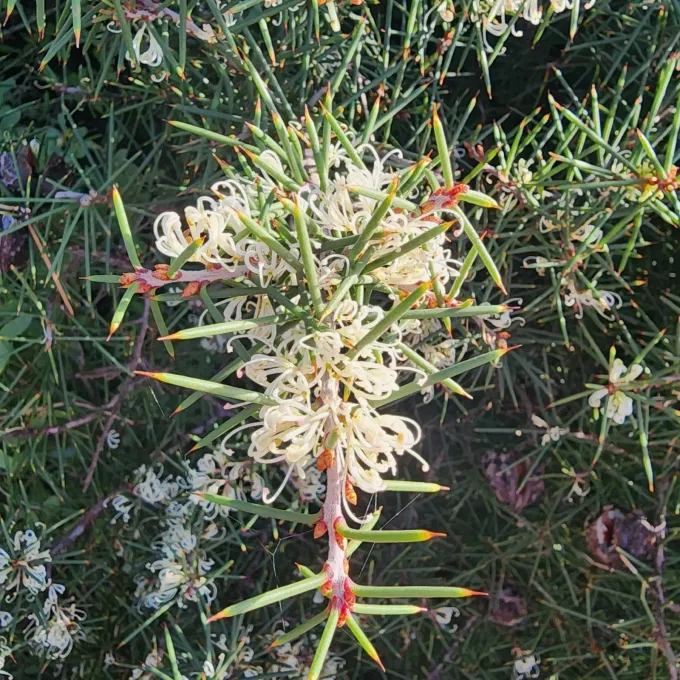
Botanically, the plant is characterized by its needle-like foliage and rigid, branched structure. It reaches a height of 2 to 6 meters, featuring small, white to pale-yellow flowers that appear in the leaf axils.
The crop thrives in well-drained, sandy, or loamy soil types. It is sensitive to waterlogging, as the roots require consistent oxygenation to prevent decay. Full sun exposure is essential for maintaining plant vigor and promoting dense growth.
Agricultural management should focus on minimal soil disturbance. Due to the nature of the Proteaceae family, the plant is highly sensitive to phosphorus-based fertilizers; therefore, low-phosphorus or native-specific soil amendments are recommended.
Hakea decurrens is frequently utilized for erosion control and windbreak establishment. Its dense, thorny nature makes it an excellent choice for creating boundary lines that discourage livestock and wildlife entry into cropping fields.
Main diseases and pests
The primary threat to the stability of a Hakea plantation is root rot, typically caused by Phytophthora species. This occurs most frequently in soils that do not provide adequate drainage or during extended rainy seasons.
Insect pests such as scale insects and spider mites are common. These pests congregate on the stems and needle-like leaves, drawing out plant sap and weakening the overall health of the shrub.
To maintain plant health, it is vital to keep the planting rows spaced widely apart to allow for airflow. High humidity trapped within the canopy creates an ideal microclimate for various fungal pathogens to develop.
Chemical control should be employed with caution. Many Hakea species are sensitive to traditional pesticides, so integrated pest management (IPM) practices, such as encouraging natural predators, are preferred.
If signs of disease appear, such as leaf discoloration or branch dieback, the affected parts should be pruned immediately and removed from the site to prevent the spread of the pathogen to healthy specimens.