
Agave titanota
Agave titanota
Description
Growing requirements
Agave titanota is a perennial succulent plant belonging to the Asparagaceae family. Native to the arid regions of Mexico, specifically the state of Oaxaca, this species is naturally adapted to growth on rocky, calcareous slopes under intense solar radiation.
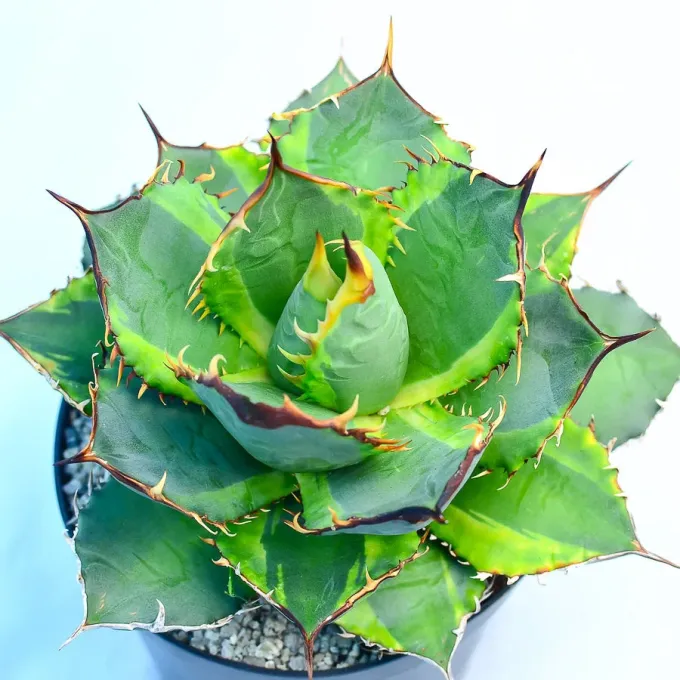
The plant features compact rosettes composed of thick, rigid, bluish-gray or green leaves. Its botanical signature includes sharp marginal spines that provide a striking aesthetic appeal, making it a highly sought-after specimen among succulent enthusiasts and collectors.
For successful cultivation, Agave titanota requires exposure to bright, direct sunlight for the majority of the day. Insufficient lighting leads to etiolation, where the plant loses its natural compactness and structural integrity, significantly diminishing its ornamental value.
The soil requirements are strict: the medium must provide excellent drainage. A substrate consisting of gravel, pumice, and coarse sand is essential to prevent moisture accumulation around the roots, which is the primary cause of physiological decline in this species.
The primary use of Agave titanota is in ornamental horticulture. It is widely prized as a focal point in xeriscape gardens in appropriate climates and remains a staple in luxury indoor gardening and specialized succulent collections.
Main diseases and pests
Fungal pathogens associated with overwatering constitute the most significant threat to Agave titanota. Root rot and stem rot occur rapidly in poorly drained media, necessitating careful monitoring of soil moisture levels throughout the growing season.
Mealybugs are common pests that colonize the base of the leaves, drawing sap and weakening the plant structure. Integrated pest management, including systemic insecticides, is recommended to control these infestations effectively.
Spider mites may manifest in low-humidity environments, particularly during indoor cultivation. They cause chlorotic spots on the leaf surface, which can lead to permanent scarring if left untreated over an extended period.
Scale insects present a challenge by hiding within the dense leaf rosettes of the plant. Manual removal combined with targeted insecticidal treatments is usually necessary to restore the plant's health and visual appearance.
Preventive maintenance, including the use of well-aerated soil and sterilized potting tools, is vital for long-term health. Regular inspections of the foliage and root crown can help identify and mitigate potential issues before they cause structural damage.