
Wedelia glauca
Wedelia glauca (Ortega) O. Hoffm. ex Hicken
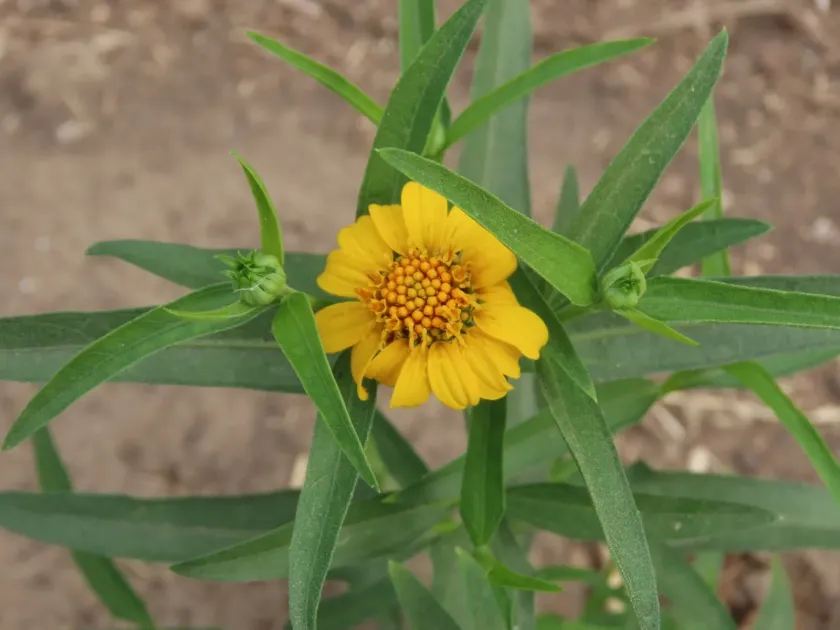
Description
Growing requirements
Wedelia glauca, a member of the Asteraceae family, is a perennial herbaceous plant recognized for its remarkable resilience and ability to thrive in diverse ecological settings. It is considered a significant weed in many agricultural areas globally.
The plant features a complex root system, consisting of both deep taproots and extensive rhizomes. This structural adaptation allows Wedelia glauca to survive harsh environmental conditions and makes it highly resistant to conventional mechanical eradication methods.
It prefers well-lit environments but maintains growth in partial shade. Its adaptability to various soil types, including saline and compact soils, allows it to invade cultivated fields, where it competes aggressively for water and nutrients.
Native to South America, specifically Argentina and Uruguay, the species has spread to various regions with similar climates. Its classification as an invasive species is primarily due to its capacity to dominate landscapes and disrupt local ecosystems.
In farming practices, the plant is noted for its high drought tolerance and rapid growth cycle. It efficiently extracts resources from the soil, often leading to a substantial decrease in the biomass and yield of primary agricultural crops nearby.
Main diseases and pests
The primary threat posed by Wedelia glauca is its ability to spread vegetatively. Standard cultivation practices like plowing or tilling often fragment the rhizomes, leading to new growth points and further infestation.
The plant exerts significant pressure on cultivated crops through both physical competition for space and potential allelopathic effects that inhibit the growth of surrounding vegetation.
There are no documented major pests or diseases that provide biological control of Wedelia glauca; hence, it remains a persistent challenge for farmers in affected regions.
Natural enemies of the plant are generally insufficient to curb its population density in an agricultural context, requiring persistent integrated management strategies.
Chemical control involving systemic herbicides is currently the most reliable method for managing infestations, targeting the extensive root system to prevent regeneration.