
Veitchia joannis
Veitchia joannis
Description
Growing requirements
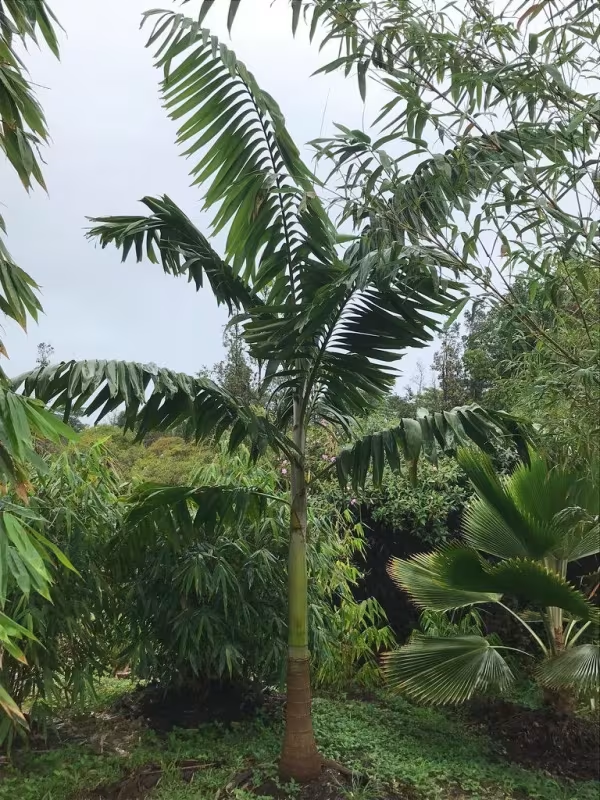
Veitchia joannis belongs to the Arecaceae family. This magnificent tree-like plant reaches significant dimensions in its natural habitat, forming a solitary, smooth, and upright trunk of a grey color with distinct ring-like scars left by fallen leaves.
The plant originates from the Fiji islands, where it thrives in humid tropical rainforests. Its cultivation range is limited to tropical and subtropical regions, as the culture is extremely sensitive to temperature drops and cannot withstand frosts at all.
For successful development, this palm requires high air humidity and consistently warm temperatures throughout the year, preferably in the range of +22 to +28 degrees Celsius. The plant prefers areas with good lighting, but in its youth, it requires protection from direct sunlight, which can cause leaf burns.
The soil must be fertile, light, and possess excellent drainage. An ideal substrate is a mixture of turf soil, peat, and coarse sand. It is essential to provide a high-quality drainage layer, as moisture stagnation in the root system is fatal to this species.
In ornamental gardening, this culture is valued for its elegant crown of pinnate leaves in a rich green color. It is often used in landscape design as a specimen plant or for creating avenue plantings in tropical resort park areas.
Main diseases and pests
The main pests threatening the Veitchia are spider mites and mealybugs, which become active when air humidity is insufficient. Regular spraying of the crown and inspection of the leaf blades help prevent mass infestation.
Among fungal diseases, root rots are the most dangerous, developing due to systematic waterlogging of the substrate or the use of heavy soil mixtures. Prevention consists of controlling irrigation and maintaining proper ventilation.