
Marama bean
Tylosema esculentum
Description
Sowing dates
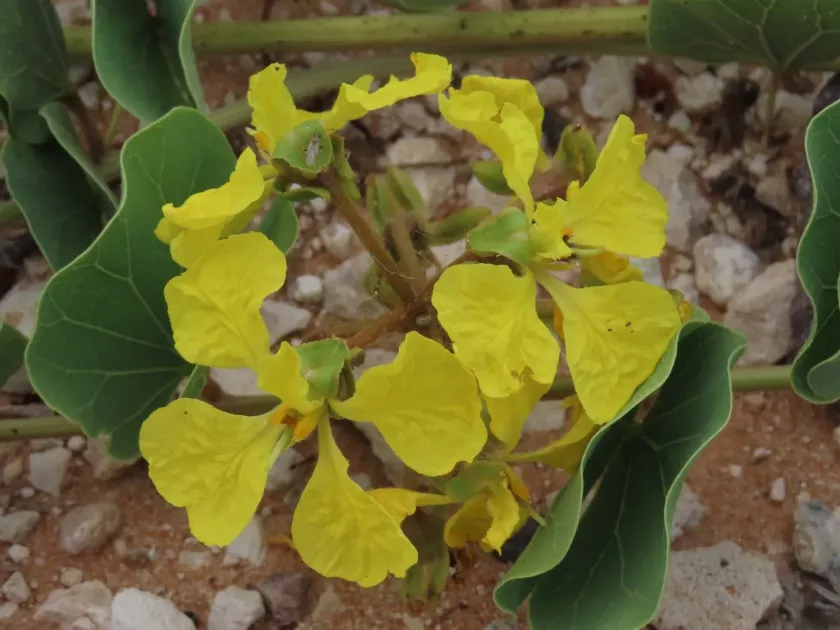
The marama bean (Tylosema esculentum) is a long-lived, sprawling, herbaceous perennial legume belonging to the Fabaceae family. It is renowned for its resilience in arid African environments, where it grows as a trailing vine from a large, deep-seated underground tuber.
Sowing typically occurs at the beginning of the rainy season, as the seeds require consistent moisture for germination. In agricultural settings, seeds are planted directly into well-drained soil once the temperature rises, ensuring they are positioned to accommodate the plant's expansive growth.
Germination requires soil temperatures of at least 25 degrees Celsius. Because the seeds possess a very hard, water-impermeable testa, mechanical scarification is often practiced to improve water uptake and speed up uniform emergence.
The plant develops a deep root system, so proper spacing is essential to minimize intraspecific competition for water and soil nutrients, which is crucial in semi-arid regions.
Marama beans are known for their ability to establish symbiotic relationships with nitrogen-fixing bacteria, allowing them to thrive in nutrient-poor sandy soils and potentially contribute to soil fertility restoration.
Growing requirements
Marama bean prefers well-drained, sandy soils and is highly intolerant of waterlogged conditions, which can lead to tuber rot. The plant's structure is perfectly adapted to minimize water loss and maximize resilience in dry conditions.
The crop requires full sun exposure for optimal growth and development. It is a thermophilic plant, thriving in temperatures that would be fatal to most common horticultural legumes.
There is no specific requirement for high fertilization, as the plant is naturally adapted to survive on minimal soil resources. However, light phosphate supplementation can encourage better establishment in very degraded lands.
Climate adaptation is the marama bean's greatest strength; it thrives in areas with low, erratic rainfall. It is entirely frost-intolerant, making its cultivation range restricted to warmer tropical and subtropical zones.
Weed control is primarily needed during the establishment phase, as the young, slow-growing vines can be easily outcompeted by aggressive weeds until the plant becomes fully established.
Yield
The economic value of the marama bean lies in its high-protein, high-fat seeds, which are highly nutritious and serve as a staple food source in many parts of the Kalahari Desert region. Seeds contain up to 35% protein and 40% fat.
Yield depends heavily on environmental conditions and plant age. Each plant can produce dozens of pods, and active research aims to domesticate the plant to improve pod uniformity and total seed yield per hectare.
The underground tuber is also edible, rich in starch and protein, though it is usually only harvested when the plant is old or during periods of extreme food scarcity, as harvesting the tuber destroys the perennial vine.
Successful yield depends on effective pollination, usually provided by native bee populations. Maintaining local biodiversity is essential for ensuring consistent crop production in farming systems.
The harvest index is currently low due to the wild nature of the crop, but selective breeding focusing on higher seed production and synchronized ripening shows great promise for future agricultural implementation.
Main diseases and pests
Tylosema esculentum displays a high level of natural immunity to most standard agricultural diseases, largely due to its evolutionary adaptation to arid environments where pathogen pressure is lower.
In humid or unseasonably wet conditions, the primary threat is fungal rot affecting the roots and tubers. Proper site selection and drainage management are the most effective ways to mitigate this risk.
Insect pests that target the leaves can impact the plant's vigor, especially during the peak of the growing season. Small-scale management often involves manual control or biological pest suppressants.
Seed-boring insects can damage the crop within the pods, so timely harvest is critical to reduce the window of exposure to these pests. Storage protection is also necessary for dried seeds.
Larger animals and rodents often dig up young tubers or eat new shoots. Fencing and protective netting are typically used to safeguard experimental plots from wildlife damage.
Harvesting
Harvesting is typically done manually as the pods mature and dry on the vine. Because ripening is often non-uniform, farmers must perform multiple passes across the field to collect all mature pods.
It is vital to allow the pods to dry completely on the plant before collection. Premature harvesting can result in seeds with high moisture content, leading to rapid spoilage during storage.
After collection, seeds are threshed and sun-dried to ensure a long shelf life. Proper storage in cool, dry conditions is sufficient to maintain their nutritional quality for extended periods.
Marama beans must be roasted or boiled before consumption. Heat treatment not only improves the flavor but also destroys anti-nutritional factors that may be present in the raw legumes.
The remaining vegetative matter is often left in the field as mulch, protecting the soil surface from the heat of the sun and helping to retain soil moisture for the subsequent season.