
Traganum nudatum
Traganum nudatum
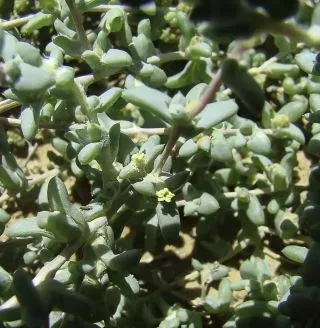
Description
Growing requirements
Traganum nudatum is a perennial subshrub belonging to the Amaranthaceae family, subfamily Chenopodioideae. It is a highly specialized xerophyte and halophyte, perfectly adapted to the harsh conditions of the deserts and semi-deserts of North Africa and Southwest Asia.
The plant features a robust root system capable of reaching deep moisture reserves. Its stems are densely branched and covered with succulent leaves, which act as a water storage organ to survive intense solar radiation and prolonged droughts.
Traganum nudatum thrives in sandy, stony, or saline soils. It is well-known for its salt tolerance, making it an excellent candidate for the phytoremediation of degraded lands and restoring soil health in arid environments where other vegetation fails to grow.
Climate requirements include high levels of solar exposure and very low atmospheric humidity. The plant is extremely sensitive to waterlogging, as its roots require excellent aeration to prevent rot, making the choice of location critical for successful cultivation.
In its native habitat, the plant plays a vital role in sand stabilization. By anchoring shifting dunes with its extensive root system, Traganum nudatum prevents soil erosion and creates a sheltered micro-niche for secondary desert flora to colonize.
Yield
The primary economic use of Traganum nudatum is as a forage resource for camels, goats, and sheep. In many arid regions, it serves as a critical source of green fodder during the peak of the dry season when other vegetation becomes dormant or non-existent.
Beyond its fodder value, the plant is being researched for its biomass potential. Under controlled conditions with minimal irrigation, it can produce a consistent yield of dry matter, offering potential for use in desert-based bio-energy projects.
Seed germination rates are generally high, which facilitates large-scale restoration projects. When sowing, it is recommended to use mulching techniques to stabilize soil moisture until the seedlings establish their deep root structures.
Chemical analysis of the plant tissues reveals unique bioactive compounds. This makes it an interesting subject for pharmaceutical research, particularly regarding the development of treatments derived from salt-tolerant desert plant extracts.
Sustainable harvesting is essential. When used as pasture, rotation is highly recommended to allow the plant populations to recover their vigor, as overgrazing can lead to irreversible damage to the subshrub structure.
Main diseases and pests
Pests such as specialized desert locusts and other phytophagous insects pose the most significant threat to biomass production. Despite the high mineral content of the plant tissues, these pests can cause severe defoliation if left unchecked.
Fungal pathogens are largely a result of poor management, particularly when humidity levels remain too high for extended periods. Fusarium-related root rots can be problematic if the soil drainage is compromised or if planting density is too high.
Human activities represent the most persistent threat to natural populations. Overgrazing and the removal of shrubs for fuel contribute to desertification, which reduces the plant's ability to protect the soil from wind erosion.
Invasive weed species can compete for limited resources during the seedling stage. Periodic manual weeding in the early development phase of a plantation is recommended to ensure the young Traganum plants have sufficient access to space and nutrients.
Effective management includes regular monitoring for early signs of disease and insect infestations. Maintaining optimal spacing between individual plants ensures better air circulation, which is key to preventing the spread of humidity-related pathogens.