
Lesser stitchwort
Stellaria graminea L.
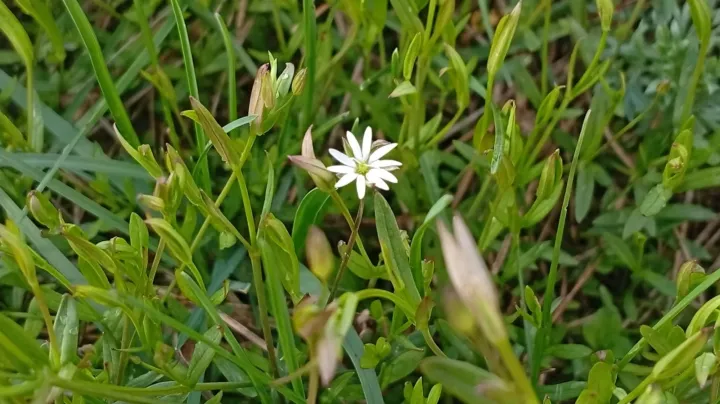
Description
Growing requirements
Lesser stitchwort (Stellaria graminea L.) is a perennial herbaceous plant belonging to the Caryophyllaceae family. It is widely recognized as a persistent weed in pastures, meadows, and grain fields across temperate regions.
The plant is characterized by its weak, four-angled stems and narrow, grass-like leaves. Its delicate appearance often hides its aggressive growth habit; the plant propagates through creeping rhizomes, forming dense mats that can easily outcompete young crop sprouts.
It thrives in various soil types, particularly favoring moist and slightly acidic conditions. Lesser stitchwort is highly shade-tolerant, which allows it to persist under the canopy of cereal crops or dense forage stands, making mechanical removal difficult.
The native range of the species covers most of Europe and temperate Asia. It has successfully adapted to diverse climatic zones, showing significant resistance to cold temperatures and the ability to thrive in early spring when competition is still developing.
In agricultural practice, lesser stitchwort is primarily managed as a nuisance weed. While it contributes slightly to biodiversity in wild meadows, it is highly detrimental in arable farming, where it reduces yields by competing for resources and harbouring pests.
Main diseases and pests
Lesser stitchwort acts as an alternative host for several pests, including aphids and thrips. These insects can transmit viral diseases from the weed to cash crops, leading to significant economic losses in cereal production.
The species is susceptible to various fungal pathogens, such as rusts and powdery mildew. When these fungi colonize large patches of the weed, they can easily spread to sensitive crops, particularly in seasons with high humidity and poor ventilation.
Control strategies often involve deep tillage to disrupt the rhizome network, though this is limited in reduced-tillage systems. Selective herbicides are the most common solution for established infestations in cereal crops.
Integrating crop rotation is vital. By switching to competitive, broad-leaved crops or utilizing cover crops that shade the ground early, farmers can significantly suppress the growth of lesser stitchwort patches.
Integrated weed management, combining chemical and mechanical control methods, is necessary to minimize the seed bank in the soil and prevent future outbreaks in the field.