
Sinocrassula indica
Sinocrassula indica
Description
Growing requirements
Sinocrassula indica is a distinct succulent species belonging to the Crassulaceae family. Originally native to the mountainous regions of Asia, including China and the Himalayas, it is well-adapted to rocky environments and well-drained slopes.
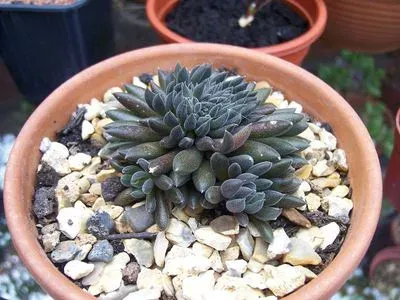
This succulent is characterized by its compact, often dark-colored rosettes of fleshy leaves. It is a slow-growing species that is highly valued by collectors for its unique appearance and architectural form within decorative containers.
Cultivation requires plenty of bright, indirect sunlight to maintain its compact shape. In environments with poor lighting, the plant will etiolate, losing its characteristic rosette form and becoming weak and prone to collapse.
The substrate must be extremely porous and well-draining. A typical mix includes coarse sand, pumice, or perlite combined with a small amount of organic potting soil to ensure that water does not remain around the roots.
Watering should be approached with caution. It is critical to allow the soil to dry out completely between waterings, as the roots are highly sensitive to stagnant moisture and prolonged dampness.
Main diseases and pests
Common pests affecting Sinocrassula indica include mealybugs, which tend to hide in the tight crevices between the succulent leaves, and root aphids that infest the underground system.
Fungal diseases are the most significant threat, often caused by overwatering or poor air circulation. Symptoms include darkened, mushy stems and wilting leaves that detach from the plant easily.
To prevent disease, it is essential to ensure adequate airflow around the base of the plant. Avoiding overhead watering helps prevent moisture accumulation in the sensitive rosette center.
Treatment for infestation involves the application of appropriate contact or systemic insecticides, while fungal issues require removing the infected parts and repotting in sterile substrate.
Healthy plants are maintained by strictly following a seasonal cycle, providing a cooler and drier environment during the winter months to match its natural dormancy requirements.