
Scybalium jamaicense
Scybalium jamaicense
Description
Growing requirements
Scybalium jamaicense is a highly specialized parasitic plant species belonging to the Balanophoraceae family. It is a holoparasite, meaning it lacks chlorophyll entirely and relies exclusively on its host plant to obtain water and essential nutrients through specialized root structures.
The native range of this species is primarily the Caribbean, with a strong focus on Jamaica and neighboring regions. It grows in tropical, humid forests where it thrives in the sheltered, moist environment provided by the dense forest canopy and deep leaf litter.
In terms of agricultural potential, Scybalium jamaicense is not a crop that can be domesticated or farmed in a conventional sense. Its survival is strictly tied to its host trees, and it lacks the independent metabolic pathways required for cultivation in commercial agricultural systems.
The plant requires specific soil conditions characterized by rich organic matter and consistent moisture levels. Because it does not perform photosynthesis, it does not require direct sunlight and is typically found in the dark, shaded understory of tropical forests.
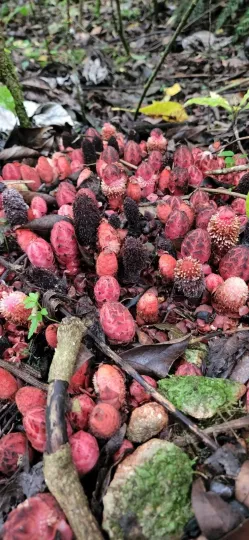
Botanically, the plant is known for its fleshy, tuberous base that connects to the host root system. The aerial part of the plant consists of complex inflorescences that emerge from the ground, mimicking the appearance of fungi, which allows the plant to reach maturity and produce seeds without ever having leaves.