
Schismus barbatus
Schismus barbatus
Description
Sowing dates
The timing of sowing is entirely dependent on the onset of seasonal rainfall, as moisture is the limiting factor for germination in its native habitat.
In practice, seeds should be sown just before expected rain events to maximize the benefit of soil moisture for root establishment.
Minimal soil cover is required, as the small seeds can fail to emerge if buried too deeply in loose desert soils.
In controlled agricultural settings, the density of sowing must be adjusted based on the expected rainfall patterns to prevent inter-plant competition for water.
Successful establishment is marked by rapid root growth, which allows the plant to survive subsequent dry spells that often occur after initial germination.
Growing requirements
Schismus barbatus, commonly known as the Arabian grass or Mediterranean grass, is a member of the Poaceae family. It is a small, tufted annual grass highly adapted to desert and arid environments.
The plant originates from the Mediterranean region, the Middle East, and parts of Africa, where it thrives in harsh climatic conditions with limited annual precipitation.
It prefers sandy or gravelly soils and can tolerate moderate levels of soil salinity, making it a pioneer species in disturbed arid landscapes.
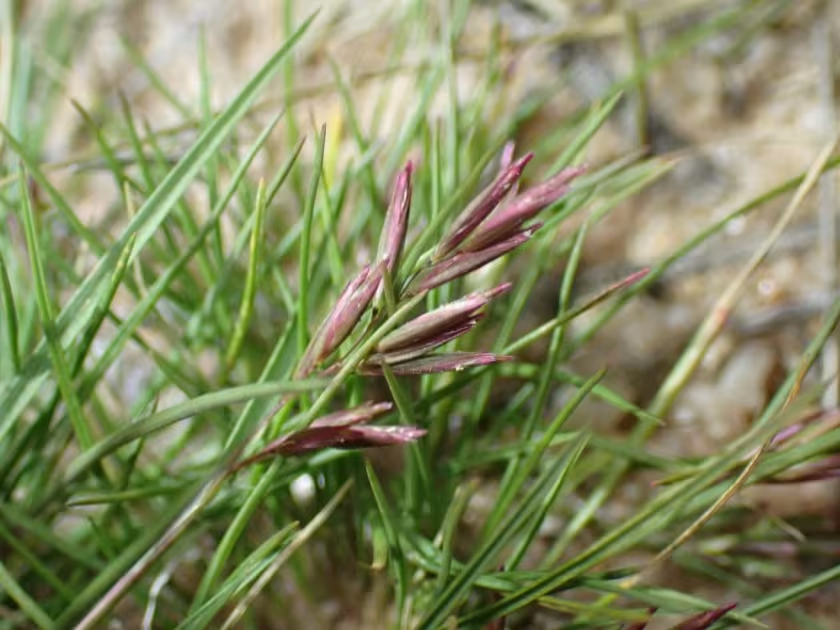
Botanically, it is characterized by its prostrate to erect growth habit, narrow leaf blades, and dense, panicle-like inflorescences that appear after winter rains.
The species is highly light-demanding and requires full sun to achieve optimal biomass production, failing to develop well in shaded environments.
Yield
The primary use of Schismus barbatus is as a forage resource for livestock, particularly in grazing systems within arid regions.
It provides early-season green fodder, which is vital for the nutritional needs of sheep and goats when other feed sources are unavailable.
Though individual plants are small, the species can form dense, productive mats in favourable years, contributing significantly to total forage biomass.
Beyond green forage, the dormant dried foliage serves as a reserve feed, offering essential energy for herbivores during the hot, dry summer months.
The ability of the plant to produce a high number of seeds ensures its persistence in grazing lands, facilitating natural reseeding and stand recovery.
Main diseases and pests
Fungal diseases are the primary threat, especially when unseasonable high humidity levels occur, leading to leaf spot or rust infections.
Pests such as aphids and various grass-feeding larvae can cause significant damage during the active growing season by consuming succulent plant tissue.
Overgrazing remains a major management challenge, as excessive trampling can destroy the soil structure and reduce seed bank density for future years.
Root rot becomes a significant issue if the plants are grown in areas with poor drainage or where irrigation water accumulates excessively.
The competition from invasive, more aggressive plant species can suppress the growth of Schismus barbatus in areas that are seeing increased nitrogen deposition or land degradation.