
Crystalwort
Riciella fluitans
Description
Growing requirements
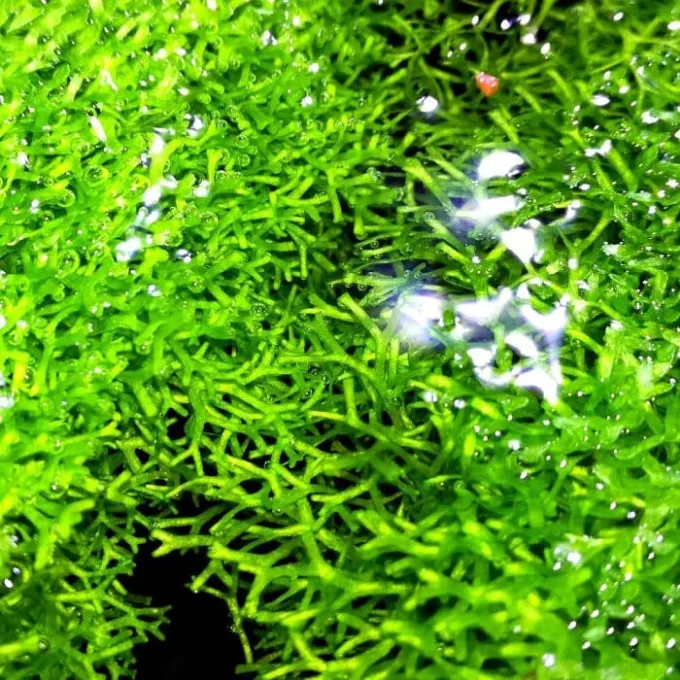
Crystalwort (Riccia fluitans) is a liverwort belonging to the Ricciaceae family. It is a thalloid plant that lacks true roots, stems, and leaves, consisting instead of a branched, flattened thallus that floats on the surface of water bodies.
This species has a cosmopolitan distribution, occurring naturally in a wide range of climates across the globe. It is commonly found in stagnant or slow-moving freshwater habitats, adapting well to diverse ecological niches.
For successful cultivation, water temperatures should be maintained between 20 and 28 degrees Celsius. The plant thrives in soft to medium-hard water with a slightly acidic to neutral pH level, which optimizes its metabolic functions.
High levels of light are essential for the growth of Crystalwort. Insufficient lighting causes the thallus to become elongated, pale, and brittle, often leading to the disintegration of the colony if proper light intensity is not restored.
Agricultural techniques for this species include the addition of CO2 and essential micronutrients to boost biomass production. In aquaculture settings, it is often secured to mesh substrates to create dense, aesthetically pleasing green carpets.
Yield
The economic value of Riccia fluitans lies in the aquarium trade and aquatic landscape design. Due to its rapid vegetative growth, the species is considered highly productive, yielding consistent harvests under stable environmental conditions.
Under optimal lighting and nutrient availability, the biomass of the colony can double within 7 to 10 days. This rapid growth cycle allows for frequent harvesting, ensuring a steady supply of high-quality plant material for the market.
Crystalwort is also utilized in water treatment systems, where its ability to absorb nitrates and phosphates makes it an effective biological filter. This dual-purpose usage adds value to the cultivation process beyond ornamental production.
Harvesting is typically done manually or using fine-mesh nets to skim the excess biomass from the surface. The plant recovers quickly after thinning, provided the remaining colony has adequate space and nutrients to expand.
Post-harvest handling requires strict moisture control. The plant is extremely sensitive to desiccation, so it must be stored or transported in sealed, humidified packaging to maintain its structural integrity until it reaches the end user.
Main diseases and pests
The most significant threat to Crystalwort cultures is infestation by filamentous algae. Once algae interweave with the thalli, they are nearly impossible to remove without damaging the fragile structure of the plant.
Aquatic pests, including snails and certain insect larvae, can cause physical damage to the thallus in open-air ponds, leading to localized die-off and the potential spread of pathogens within the colony.
Water chemistry instability is a primary abiotic threat. Sudden fluctuations in pH or sudden spikes in nutrient concentrations can trigger chlorosis, resulting in the whitening of the segments and a breakdown of the photosynthetic apparatus.
Stagnant water without proper surface movement can lead to the accumulation of waste gases, which inhibits gas exchange and promotes bacterial growth. This leads to the rotting of the submerged layers of the moss.
Fungal pathogens represent a constant danger in systems with high organic waste loads. These infections rapidly degrade the plant tissue, turning the bright green thalli into a non-viable, decaying slurry if not managed promptly.