
Praxelis clematidea
Praxelis clematidea
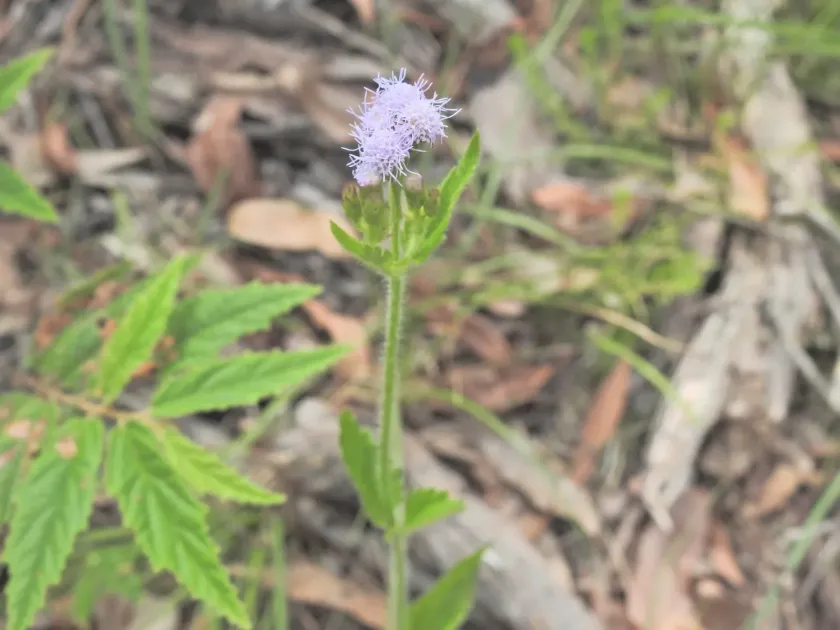
Description
Growing requirements
Praxelis clematidea is a perennial herbaceous plant belonging to the Asteraceae family. Originating from South America, it has gained global attention as a highly invasive species that thrives in various subtropical environments, often disrupting local ecosystems.
The plant exhibits high adaptability to different soil types, flourishing in nutrient-poor soils, disturbed areas, roadsides, and agricultural land. It thrives in sunny conditions and requires minimal moisture to establish a dominant presence in the field.
Botanically, it features upright, branching stems that reach heights of up to 80 cm. The leaves are opposite and serrated, and the inflorescences consist of small, lavender-to-blue tubular flowers that produce numerous wind-dispersed seeds.
Agronomic management is challenging due to the plant's high reproductive capacity and the longevity of its seeds in the soil. Farmers often struggle with its presence in pastures, where it competes aggressively with forage grasses for water and nutrients.
While not a traditional agricultural crop, its study is vital for modern agronomy. Understanding its growth cycle is the first step toward effective field management and minimizing its negative impact on crop production systems.
Main diseases and pests
The primary threat posed by Praxelis clematidea is its status as a competitive weed. It outcompetes local flora and desired crops, leading to significant yield reductions and increased costs for manual or chemical weed removal.
Typical plant diseases and pests that affect commercial crops rarely impact this resilient species. This lack of natural biological constraints allows it to proliferate unchecked if not managed through rigorous agricultural practices.
Effective control strategies focus on mechanical eradication before the flowering stage to prevent seed dispersal. Chemical herbicides applied during the vegetative growth stage have shown some success in limiting population density.
Integrated pest management (IPM) is essential to suppress the spread of this weed. Ongoing research aims to identify potential biological control agents that could naturally regulate its growth in non-native territories.
Maintaining high standards of farm hygiene, including cleaning machinery after traversing infested areas, is crucial to prevent the spread of seeds. Regular monitoring of borders and field edges is highly recommended for early detection.