
Water hyacinth
Pontederia crassipes
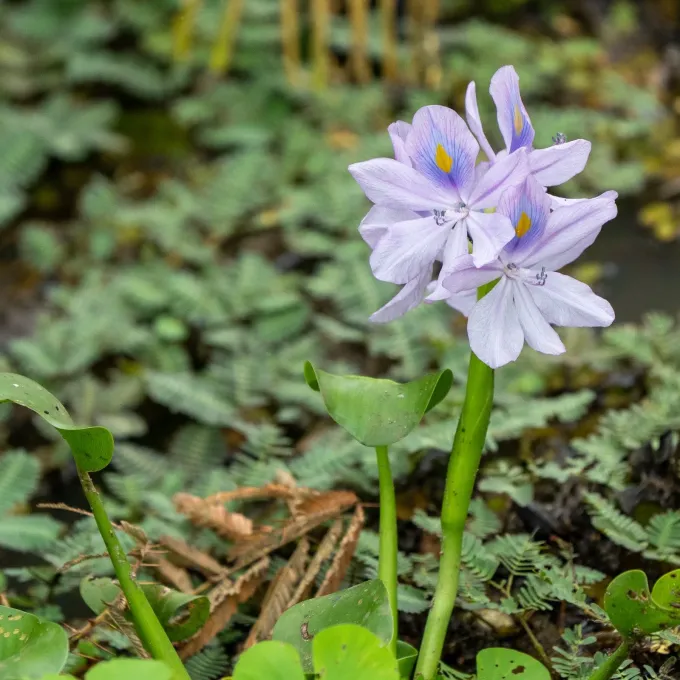
Description
Sowing dates
Propagation of water hyacinth is primarily vegetative. In temperate regions, plants are introduced into open water bodies in late spring once water temperatures consistently exceed 20°C (68°F).
The plant multiplies by producing daughter rosettes on stolons that extend from the parent plant. To encourage rapid expansion, maintain adequate spacing between initial specimens to allow for the development of these lateral shoots.
In controlled environments such as greenhouses or aquaria, propagation can continue year-round. Success depends on providing high light intensity, which is essential to compensate for the lack of tropical sunlight and support sustained growth.
The floating rosettes are simply placed on the water surface; they do not require rooting in soil. Their feathery roots absorb nutrients directly from the water column, making them highly efficient in nutrient-rich environments.
Plant density management is crucial for aesthetic and ecological balance. It is advisable to restrict the initial population to prevent the plants from quickly covering the entire surface of the water body.
Growing requirements
Water hyacinth belongs to the family Pontederiaceae and is a free-floating tropical macrophyte. Native to the Amazon Basin, it has adapted to colonize vast areas of freshwater habitats throughout the tropics and subtropics.
The plant thrives in temperatures between 25°C and 30°C. Growth slows significantly below 15°C, and the plant cannot survive freezing temperatures, which necessitates indoor wintering in cooler climates.
High light intensity is vital for the development of its iconic, showy flowers and robust foliage. In shaded or low-light conditions, the plants become spindly, and the characteristic bulbous leaf petioles fail to develop properly.
Water quality plays a significant role in plant health. Eicchornia excels in water with high levels of organic nitrogen and phosphorus, effectively acting as a natural filter by absorbing these pollutants from the water column.
Maintenance of the root system is an indicator of environmental quality. Healthy, well-functioning roots appear light, feathery, and either white or violet, whereas dark or decaying roots indicate poor water quality or toxicity.
Yield
Water hyacinth is one of the fastest-growing plants in the world. Under ideal conditions, a colony can double its biomass in as little as one to two weeks, leading to massive annual yields.
The harvested biomass serves as a high-quality organic fertilizer. Once composted, it releases nitrogen and vital micronutrients back into the soil, significantly improving soil structure and fertility in agricultural applications.
In the context of industrial waste management, water hyacinth is used for biogas production. Its high carbohydrate content makes it an excellent substrate for anaerobic digestion, yielding significant methane production.
Some livestock operations use dried or processed water hyacinth as a feed supplement. Thermal treatment is required to eliminate potential accumulation of heavy metals or pathogens from the water it previously occupied.
Yield management requires regular harvesting to prevent water stagnation. By consistently removing excess biomass, the plant's growth rate is kept at its peak metabolic capacity, maximizing its efficiency as a biological filter.
Main diseases and pests
Water hyacinth is generally resilient to disease in introduced environments. However, iron deficiency often causes leaf chlorosis, characterized by yellowing of the foliage, which can be corrected by adding chelated iron to the water.
In its native range, the plant is controlled by specialized insects such as the Neochetina weevil. These biological agents feed on the leaves, effectively keeping the population in check in its natural South American habitat.
In closed indoor systems, aphids or spider mites may occasionally infest the flowering stalks. Chemical treatments should be avoided due to the sensitivity of the water quality; physical removal is preferred.
Chemical contamination, such as oil spills or herbicide runoff, can be lethal. These substances rapidly damage the delicate root system, causing it to turn black and die, which often leads to the death of the entire rosette.
The greatest threat is the plant's own invasive potential. Without proper monitoring, it can outcompete native aquatic flora, leading to the collapse of local biodiversity and the clogging of waterways.
Harvesting
Harvesting is typically carried out using mechanical means such as rakes, nets, or specialized aquatic harvesting machinery. These tools ensure the efficient removal of plant material from large water surfaces.
The optimal time for harvesting is during the peak of the growing season. This ensures that the collected biomass is nutrient-rich and prevents the decay of submerged older parts of the plants that would pollute the water.
Collected biomass should be allowed to drain and partially dry to reduce its high water content before transportation. This step is essential for efficient logistics and to speed up the decomposition process in compost heaps.
Care must be taken to remove even small fragments of rosettes during harvesting. Because of its prolific regenerative capacity, leaving any small pieces in the water can lead to a rapid regrowth of the population.
Wintering procedures involve removing the plants from outdoor ponds and placing them in indoor containers with clean water. Constant light and temperatures above 18°C must be maintained to preserve the stock for the next season.