
Riverweed
Podostemum ceratophyllum
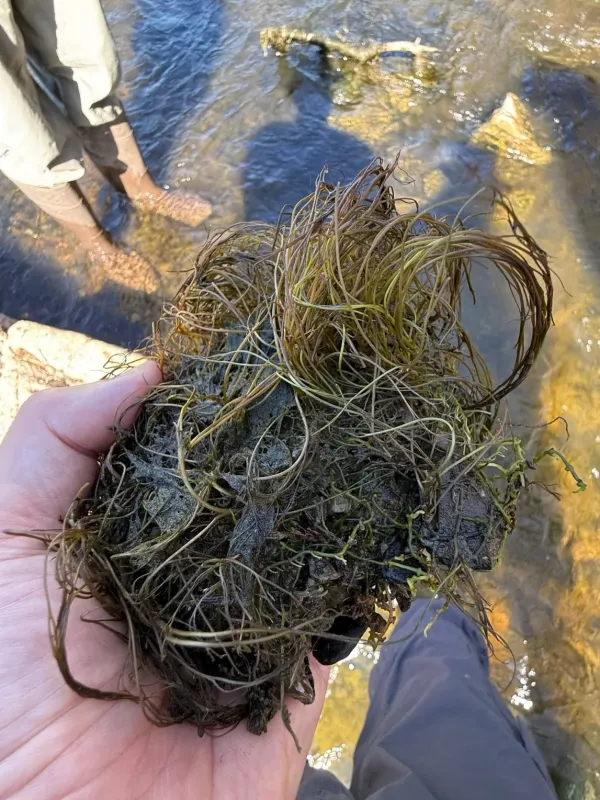
Description
Growing requirements
Riverweed (Podostemum ceratophyllum) is a fascinating aquatic plant belonging to the Podostemaceae family. It is distinct for its specialized adaptation to life in fast-flowing water environments, primarily in North American rivers.
The plant grows attached to rocky substrates in clear, oxygen-rich streams. It acts as a primary producer in high-energy aquatic ecosystems, providing habitat for various aquatic invertebrates and fish fry.
Botanically, it lacks traditional true roots, instead using a structure known as a hapteron to anchor itself firmly to rocks. Its leaves and stems are finely divided, allowing them to remain submerged and functional under heavy water current pressure.
Optimal conditions for growth include stable, cool water temperatures and high dissolved oxygen levels. The plant is extremely intolerant of siltation, which smothers its ability to absorb dissolved minerals from the flowing water.
In terms of agricultural or commercial use, Riverweed is not a standard crop. Its significance lies mainly in environmental conservation and its role as an indicator of river health, as it disappears rapidly from degraded or polluted aquatic systems.
Main diseases and pests
The primary threat to Podostemum ceratophyllum is the degradation of its specific habitat due to human activity, particularly urbanization and agriculture.
Sedimentation from runoff effectively prevents the plant from attaching to rocks, causing localized populations to collapse.
Hydroelectric dam construction transforms river segments from rapid streams into reservoirs, which are unsuitable for this obligate rheophyte.
Eutrophication from nutrient runoff encourages algal blooms that shade the plant, inhibiting its photosynthesis and long-term viability.
While invasive aquatic species can compete for space, the physical stress of the river environment remains the primary natural limiting factor for the growth and spread of this species.