
Plicosepalus acaciae
Plicosepalus acaciae
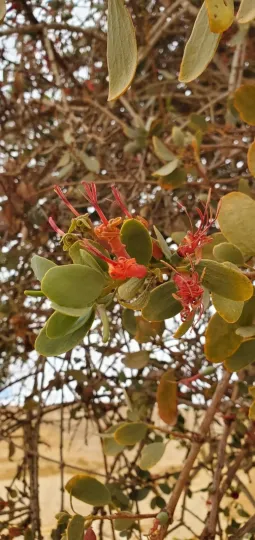
Description
Growing requirements
Plicosepalus acaciae belongs to the Loranthaceae family and is a specialized hemiparasitic plant. It is an epiphytic shrub that typically colonizes the branches of various woody species, most notably those of the Acacia genus.
The native habitat of this plant includes the arid zones of Africa and the Middle East. It has evolved to survive in extreme desert climates, enduring high temperatures and very irregular rainfall patterns throughout the year.
Its primary survival strategy is the formation of haustoria, specialized organs that penetrate the host tree's xylem. This allows the plant to siphon off water and dissolved nutrients, which it then uses for photosynthesis within its own green leaves.
The plant requires high light intensity to maintain its photosynthetic activity. Since it lacks a traditional root system that touches the soil, its life cycle is entirely dependent on the physiological health of the host tree.
Adaptation to these environments includes succulent-like traits that help in water conservation during extended droughts. These adaptations ensure the plant can survive even when the host tree is undergoing water stress.
Main diseases and pests
The most significant threat to the survival of Plicosepalus acaciae is the reduction of its host population. Desertification and overgrazing leading to the decline of acacia trees directly limit the available habitat for this species.
Pests that target the host tree represent a secondary risk. Damage to the host's vascular system, often caused by wood-boring insects, can restrict the flow of water and nutrients, causing the hemiparasite to wither.
Fungal infections at the point of attachment are a common physiological threat, particularly in humid microclimates that occasionally develop in these regions. These fungi can weaken the connection between the host and the parasite.
The species relies on birds for seed dispersal. Any disruption in local avian populations, which feed on the plant's berries and distribute seeds to new branches, significantly impairs the reproduction cycle of the plant.
Environmental pressure from human activity, such as wood harvesting, creates instability in the ecosystem. As the host trees disappear, the hemiparasitic colonies are unable to relocate, leading to localized extinction of the species.