
Paulownia fargesii
Paulownia fargesii
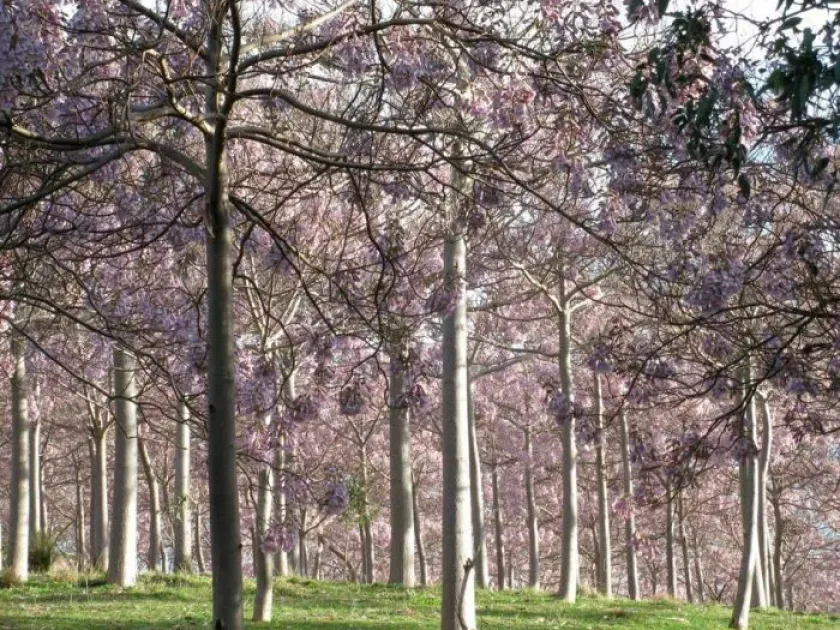
Description
Sowing dates
Planting Paulownia fargesii is ideally performed in early spring once the risk of frost has passed and the soil temperature reaches at least 12-15 degrees Celsius.
For best results, use nursery-grown saplings with a well-developed root system, ensuring they are planted at a depth that covers the root ball completely.
The planting site should be prepared by digging holes of 60x60x60 cm, enriched with organic matter to provide a nutrient boost during the critical first growing season.
Spacing is essential for optimal growth; a grid of 3x3 meters or 4x4 meters is standard for industrial plantations to ensure proper light and airflow for every tree.
After placement, firm the soil around the base and provide deep irrigation to settle the roots and eliminate air pockets that could cause root desiccation.
Growing requirements
Paulownia fargesii belongs to the Paulowniaceae family and is recognized for its superior cold hardiness, capable of surviving temperatures down to -25 degrees Celsius.
The species thrives in deep, well-drained loamy soils with a neutral pH level between 6.0 and 7.5, avoiding areas prone to waterlogging or high clay content.
Sunlight is a non-negotiable requirement; the trees must be planted in full exposure to maximize photosynthetic activity, which powers their rapid vertical growth.
Consistent water availability is crucial, particularly during the first two years, making the installation of drip irrigation systems a recommended practice for plantations.
The trees also benefit from protection against strong winds, which can easily snap the large, fragile leaves and affect the straightness of the primary leader stem.
Yield
The yield of Paulownia fargesii is typically calculated based on the harvestable timber volume produced over an 8 to 10-year rotation cycle for high-quality wood.
Annual growth rates are impressive, with trees often adding several centimeters to their trunk diameter and several meters in height each season under ideal conditions.
The wood produced is light, stable, and highly resistant to warping, making it an excellent commodity for furniture manufacturing, plywood, and high-end construction.
Beyond timber, the species contributes to soil health through high annual leaf litter production, which acts as a natural fertilizer and improves soil organic content.
Because the tree can regenerate from its own root system after harvesting, it allows for multiple harvest cycles, significantly increasing the long-term ROI of the land.
Main diseases and pests
Seedlings and young trees are susceptible to soil-borne pests like white grubs, which can damage roots and weaken the plant's ability to absorb water and nutrients.
Root rot, often caused by poor drainage or excessive irrigation, represents a major threat, leading to stunted growth or complete tree collapse in severe cases.
Foliar diseases such as powdery mildew can occur in humid environments with low airflow, requiring vigilant monitoring and timely application of antifungal treatments.
Vertebrate pests, including hares and rodents, can cause significant damage by gnawing on the bark of younger trees, necessitating the use of protective collars.
Early identification of signs of stress, such as yellowing leaves or wilting, is essential for mitigating these threats before they affect a large portion of the plantation.
Harvesting
Harvesting is ideally conducted during the dormant winter season when the moisture content in the timber is at its lowest, facilitating faster and more efficient drying.
Mechanical felling is the standard approach, performed at a low height above ground to facilitate natural regeneration from the established root system.
Once felled, the trunks are processed to remove branches and bark, then graded according to diameter and quality for industrial and commercial end-users.
Post-harvest management involves clearing the field of debris while ensuring the rootstocks are protected to support the rapid development of new, vigorous coppice shoots.
The lightweight nature of the wood makes logistics and transport more cost-effective compared to traditional hardwood species, enhancing overall operational efficiency.