
Star of Bethlehem (Bouche's)
Ornithogalum boucheanum
Description
Sowing dates
Propagation is most effectively achieved through offsets (bulblets) produced by the parent bulb. The best time for planting or dividing bulbs is late summer to early autumn, coinciding with the plant's natural dormancy period.
Bulbs should be planted at a depth of approximately 8–10 cm. A spacing of about 15 cm between individual plants ensures adequate space for root expansion and nutrient uptake, preventing overcrowding.
Seed propagation is possible but significantly slower, often taking several years for the plant to reach a flowering stage. Seeds should be sown in autumn to allow for natural stratification, which is necessary for germination.
During the spring growing season, consistent moisture is vital to support leaf development and flower initiation. However, once the foliage begins to yellow, watering should be reduced or stopped completely to allow the bulb to enter dormancy.
When grown from seed, seedlings require careful monitoring to ensure they are not crowded by weeds. Once established, the bulbs are relatively self-sufficient, requiring minimal intervention aside from seasonal cleanup.
Growing requirements
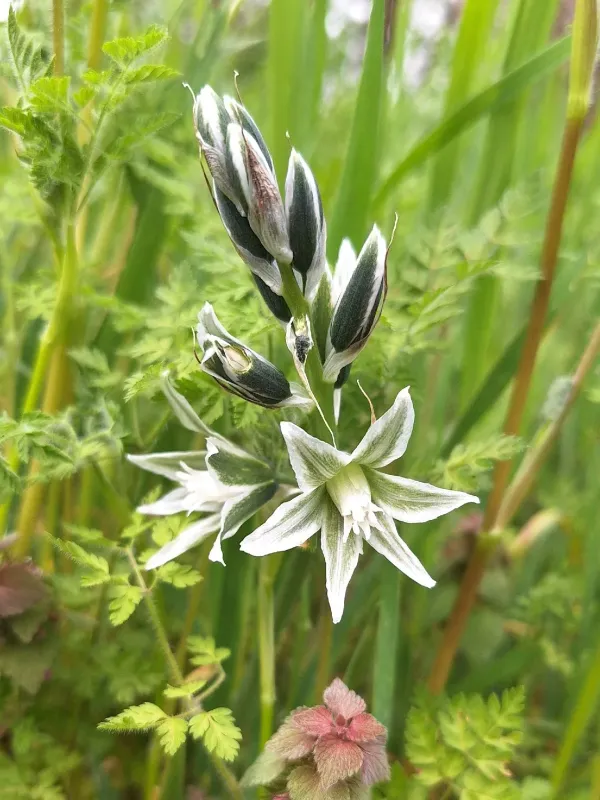
Ornithogalum boucheanum, commonly known as Bouche's Star of Bethlehem, is a bulbous perennial plant belonging to the Asparagaceae family. Native to Central and Southeastern Europe, it thrives in woodland edges, shrubby habitats, and meadows.
The plant features distinct linear basal leaves that typically wither after the flowering period. The inflorescence consists of a raceme with greenish-white flowers, each adorned with a characteristic green stripe on the exterior of the tepals.
Cultivation requires well-drained, humus-rich soil. Like many other bulbous species, it is highly sensitive to waterlogged soil, which can lead to rapid bulb decay during the dormant phase. Proper drainage is essential for long-term health.
The ideal environment includes partial shade or dappled light, mimicking its natural woodland habitat. It is hardy in temperate climates, though mulching the site in late autumn is recommended to protect bulbs from extreme frost in colder regions.
In ornamental horticulture, this species is valued for its early spring blooms. It is often used to naturalize garden spaces under deciduous trees or within shaded rock gardens, providing a subtle, refined aesthetic.
Main diseases and pests
The primary threats to Ornithogalum boucheanum are fungal diseases, most notably grey mould (Botrytis). These conditions are typically triggered by excessive soil moisture and poor airflow around the foliage.
Root rot is another common issue resulting from stagnant water in the root zone. To mitigate this, ensure the soil structure is friable and that planting sites are not located in low-lying areas where water gathers.
Pests such as bulb mites can cause damage, particularly if bulbs are stored improperly or planted in infested soil. Inspecting bulbs before planting is a critical prophylactic measure for maintaining a healthy garden patch.
Slugs and snails may occasionally feed on young spring foliage. Control measures involve manual collection, the use of organic deterrents, or the installation of physical barriers to keep these pests away from the cluster.
Maintaining a healthy growing environment through regular weeding and proper space management is the most effective way to prevent outbreaks of both pests and disease in a collection of these ornamental bulbs.