
Jacquiniella teretifolia
Jacquiniella teretifolia
Description
Growing requirements
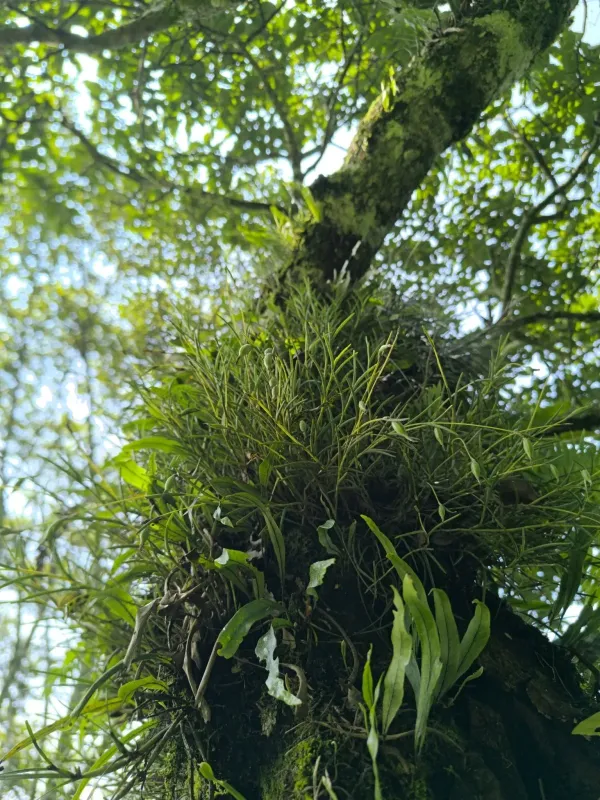
Jacquiniella teretifolia is a fascinating miniature epiphytic orchid belonging to the Orchidaceae family. Native to the tropical regions of the Americas, this species typically inhabits humid cloud forests, growing primarily on the branches of canopy trees.
The plant is easily recognized by its distinct morphology, featuring thin, terete, pencil-like leaves that are densely packed along the stem. This adaptation allows the plant to thrive in environments with varying moisture levels while maintaining efficient water storage capabilities.
Regarding cultivation, this species requires high humidity levels consistently throughout the year. It performs best when mounted on cork bark or tree fern slabs, which mimics its natural epiphytic habitat and ensures that the roots receive excellent airflow and drainage.
Lighting requirements are specific: the plant thrives in bright, filtered light. Exposure to direct midday sun should be avoided to prevent foliar damage, while insufficient light levels will hinder the plant's ability to produce its delicate flowers.
Temperature management is critical for the long-term success of this culture. A moderate climate with a distinct diurnal temperature fluctuation—slightly cooler nights compared to days—is essential to trigger the blooming process and maintain the plant's physiological balance.
Main diseases and pests
Fungal and bacterial infections are the most significant threats to the plant, usually triggered by poor ventilation and water accumulation in the leaf axils. Providing constant air movement around the plant is the most effective preventive measure.
Scale insects and mealybugs are common pests that target the tight spaces between the succulent-like leaves. Because these pests can hide deep within the foliage, infestations are often discovered only when the plant begins to show signs of stress or yellowing.
Spider mites represent a major danger in drier indoor environments. Maintaining high ambient humidity and keeping the plant well-hydrated is essential to mitigate the risk of mite infestations, which can rapidly weaken the specimen.
Root system decline is another common issue resulting from the use of poor-quality or overly decomposed potting media. As the mounting material breaks down, it can alter the pH balance, leading to root rot and nutrient absorption failures.
Integrated pest management, including regular monitoring and the use of soft contact insecticides, is recommended. Always ensure that the chemical treatments used are safe for epiphytic orchids, as their roots and leaves are highly sensitive to strong concentrations.