
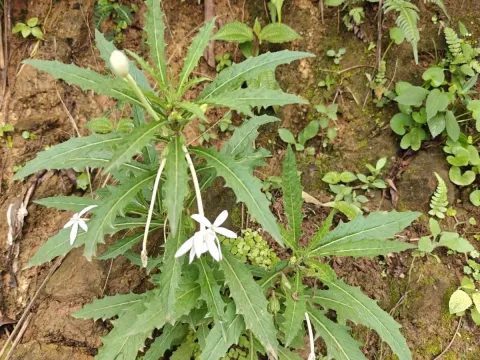
Hippobroma longiflora
Hippobroma G. Don
Hippobroma longiflora, commonly known as the Star of Bethlehem, belongs to the Campanulaceae family. Native to the West Indies and parts of tropical America, this herbaceous perennial is renowned for its striking, long, white, tubular flowers that bloom in moist, shaded environments.
What the section contains

Hippobroma longiflora
This species requires a tropical or subtropical climate to thrive. It is highly sensitive to cold, and any exposure to frost will result in immediate tissue damage. In non-tropical regions, it must be grown exclusively in temperature-controlled greenhouses or specialized indoor setups.
The plant thrives in rich, well-draining soils with consistent moisture levels. It does not tolerate prolonged dryness or waterlogged conditions, requiring a precise balance of irrigation to maintain soil moisture without inducing root rot, which is a common failure point for this crop.
Regarding light, Hippobroma longiflora prefers partial shade or dappled sunlight. Intense, direct solar radiation can scorch the leaves and dehydrate the plant rapidly. Proper ventilation is also crucial to mimic the natural forest floor conditions where this plant typically originates.
From an agricultural and commercial standpoint, it is classified as a highly toxic plant due to the presence of potent alkaloids like lobeline and nicotine derivatives. Consequently, it is not cultivated for food or fodder, and its handling requires strictly protective equipment to avoid skin or eye irritation.
Disease management for Hippobroma involves monitoring for fungal pathogens that flourish in high-humidity environments. Root rot and leaf spots are the most prevalent diseases, often triggered by insufficient soil aeration or lack of airflow within the cultivation site.
Pest threats include common greenhouse insects such as spider mites and aphids, which are attracted to the succulent foliage. Early detection and the use of integrated pest management strategies are essential to keep the population of these pests under control without damaging the plant's sensitive structure.