
Hammada articulata
Hammada articulata
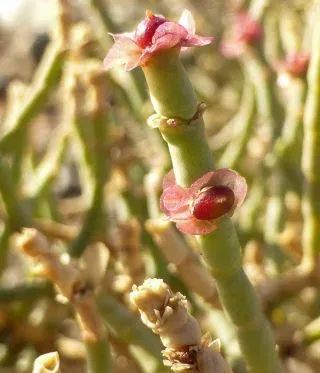
Description
Sowing dates
Hammada articulata propagates primarily through seeds, which is the standard method for restoring degraded rangelands in desert ecosystems. Seeding is usually timed to coincide with the onset of seasonal rains to ensure adequate soil moisture for germination.
In arid regions, sowing typically occurs in late winter or early spring, providing seedlings enough time to establish their root systems before the onset of extreme summer temperatures.
Precision planting techniques are often used to ensure correct seed depth, which is critical due to the small size of the seeds and their need for optimal soil contact.
Standard agricultural practices recommend seeding densities that consider the intended use of the land, whether for grazing enhancement or as a windbreak for soil stabilization.
Because initial growth is quite slow, protected areas must be established to prevent grazing livestock from trampling or consuming the young plants during their vulnerable establishment phase.
Growing requirements
Hammada articulata belongs to the Amaranthaceae family and is recognized as a quintessential xerophyte and halophyte, perfectly adapted to the harsh environments of North Africa and Western Asia.
The plant thrives in highly saline soils, making it an excellent candidate for the biological remediation and improvement of desert and semi-desert landscapes.
Optimal growth requires high solar irradiance and the ability to withstand extreme diurnal temperature fluctuations, which are characteristic of its native habitat.
Its deep taproot system allows the shrub to access moisture from subsurface layers, enabling survival during long periods of drought when most other vegetation perishes.
The crop does not tolerate shading and requires open, expansive areas to maximize its photosynthetic efficiency and overall biomass production.
Yield
The biomass yield of Hammada articulata is strictly dependent on annual rainfall patterns and soil fertility, although it remains a reliable producer in otherwise barren areas.
This shrub serves as a vital fodder reserve for camels, sheep, and goats, providing essential nutrients during the dry seasons when typical grasses are unavailable.
Sustainable pasture management ensures that the plant provides consistent annual growth, allowing it to sustain local livestock herds without exhausting the soil resources.
In many rural communities, the dry woody stems are harvested for fuel, highlighting the plant's dual-purpose role in both animal husbandry and domestic energy production.
While not a high-intensity crop, its productivity can be optimized through careful irrigation management in arid farm settings, supporting food security in desert zones.
Main diseases and pests
Hammada articulata possesses a robust natural defense mechanism against many common agricultural pests, thanks to the presence of secondary metabolites in its tissues.
While specific desert insects may feed on the succulent parts of the plant, they rarely reach epidemic levels that would threaten the survival of mature stands.
The primary threat to this species is overgrazing by domestic livestock, which can severely compact the soil and prevent the natural regeneration of the shrub population.
Human activities, such as infrastructure development and improper land management, pose significant risks by disrupting the physical integrity of the soil and root systems.
Monitoring the health of these desert phytocoenoses is essential to mitigate the effects of environmental change and ensure the long-term viability of these ecosystems.