
Dendrocalamus asper
Dendrocalamus asper (Schult. & Schult. f.) Backer ex K. Heyne
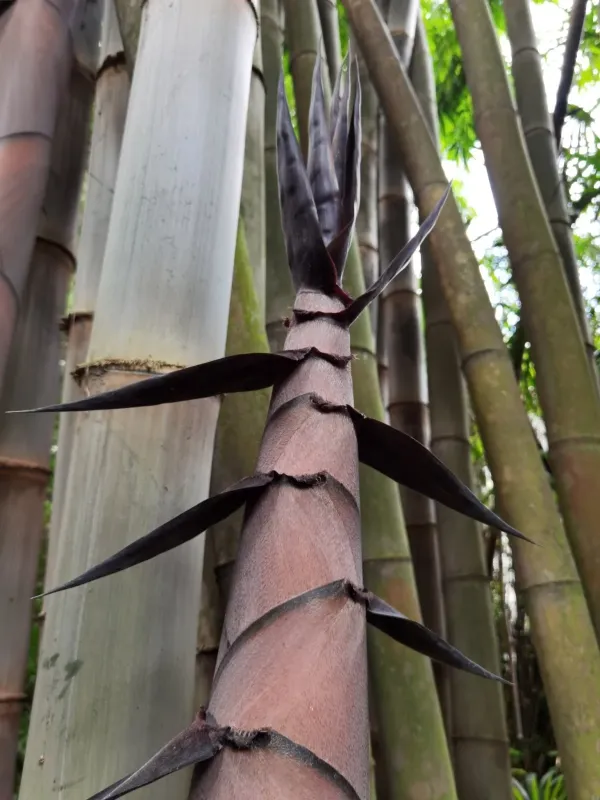
Description
Sowing dates
Propagation of Dendrocalamus asper is predominantly achieved through vegetative methods, as seeds are produced only rarely in this species. The optimal time for dividing clumps or planting cuttings is the beginning of the rainy season when the soil is maximally hydrated.
For planting, sites with high solar exposure and protection from strong winds are selected. Cuttings are harvested from young yet mature culms, ensuring at least 3-4 healthy nodes on each fragment.
On a commercial scale, seedlings are pre-nurtured in nurseries for 6-12 months until they reach a viable size. This approach minimizes mortality rates when transplanting to the permanent open field site.
The planting distance between plants when establishing a plantation ranges from 5 to 8 meters, providing sufficient nutrition area for the development of a powerful root system. Overcrowding leads to reduced culm diameter and degradation of wood quality.
Preparation of planting pits includes applying organic fertilizers, such as well-rotted manure or compost, which stimulates rapid growth after transplanting.
Growing requirements
Dendrocalamus asper is a member of the Poaceae family that has high requirements for climatic conditions. The crop prefers a tropical climate with annual rainfall ranging from 1000 to 3000 mm.
The plant develops well on nutrient-rich loamy soils with good drainage. The optimal pH level for normal growth ranges from 5.5 to 7.0.
The crop is extremely sensitive to waterlogging and water stagnation, despite its preference for high atmospheric humidity. It is essential to ensure good water drainage to prevent the rotting of powerful rhizomes during the initial vegetation period.
This bamboo species poorly tolerates low temperatures and frost, thus its commercial cultivation is limited to tropical and subtropical regions. Minimum acceptable temperatures for active growth are above 15 degrees Celsius.
During dry periods, the crop requires additional irrigation, especially in the first years of life when the root system has not yet reached deep soil horizons.
Yield
The productivity of Dendrocalamus asper is considered among the highest of all bamboo species. From one hectare of plantation, up to 20-30 tons of biomass can be obtained annually once plants reach full maturity.
Yield depends directly on agrotechnical maintenance, including regular nitrogen fertilization and clump thinning. Old and damaged culms must be removed timely to provide space for the growth of new shoots.
The primary commercial mass consists of mature culms, reaching up to 30 meters in height with a diameter of up to 20 cm. They are used as a valuable construction material due to their strength and resistance to loads.
Young shoots of Dendrocalamus asper are also a valuable product, as they are distinguished by excellent taste qualities and low bitterness content. They are harvested in the first weeks after emerging from the soil.
The economic cycle of plantation operation with proper care can last several decades, providing stable income to the producer.
Main diseases and pests
Primary threats to this bamboo species involve pests such as bamboo borers and various types of leaf-eating insects. They are capable of significantly reducing the quality of the culm wood.
Fungal diseases, arising from poor humidity regulation and inadequate plantation ventilation, can affect the root system. This manifests as yellowing of the foliage and cessation of shoot growth.
Nematodes represent a serious threat to young seedlings in nurseries, making it essential to use sterilized soil and follow proper crop rotation practices.
Weeds are serious competitors during the first two years after plantation establishment, requiring regular weeding and mulching of the tree circles.
In regions with high densities of wild rodents, measures to protect young shoots, which may be damaged during the animals' feeding process, may be required.
Harvesting
Wood harvesting begins no earlier than 4-6 years after planting, when culms reach the necessary degree of lignification. Harvesting too early leads to deformation and cracking of the material during drying.
Culms for industrial purposes are harvested during the dry season, when the starch content in tissues is minimal, which lowers the wood's attractiveness to insect pests.
Harvesting of young shoots for food purposes is conducted daily during their active growth season, usually early in the morning. They are carefully dug out without damaging the underground part (rhizome) to avoid weakening the mother plant.
After harvesting, culms must be quickly cleaned of side branches and transported to the processing site. Prolonged storage under field conditions promotes rapid mold development and loss of marketability.
An important stage of post-harvest processing is proper drying of the culms under a shed or using thermal treatment to remove excess sugar and moisture.