
Finger millet
Eleusine coracana (L.) Gaertn.
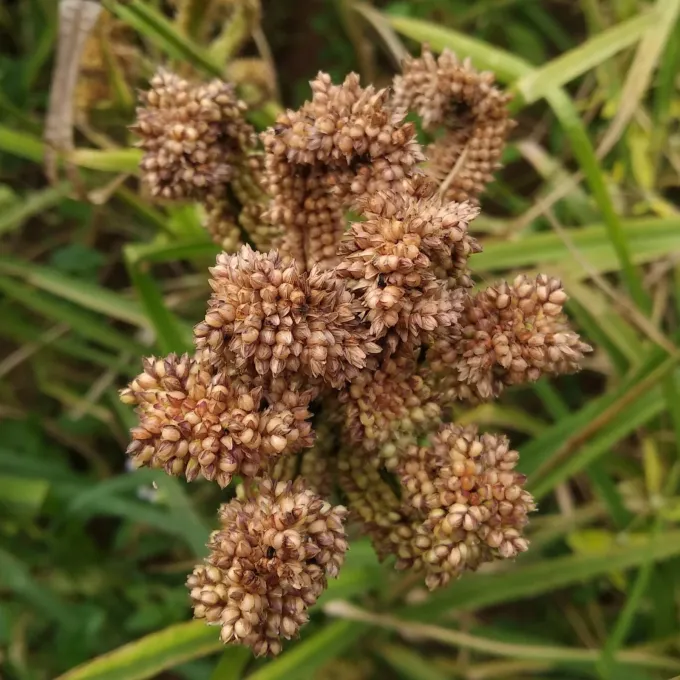
Description
Sowing dates
Finger millet (Eleusine coracana) is typically sown at the beginning of the rainy season to ensure sufficient moisture for seedling establishment and initial growth.
The ideal soil temperature for germination is between 20°C and 25°C, which encourages uniform emergence and reduces the risk of damping-off.
Farmers use either direct drilling methods or the transplanting technique, with transplanting often resulting in higher yields due to better plant density management.
The seeding rate is relatively low because of the tiny size of the seeds, necessitating a finely pulverized seedbed and shallow planting depth of about 1-2 cm.
Proper spacing is crucial for tiller development, with typical row spacing ranging from 25 to 30 cm depending on the specific cultivar and soil fertility.
Growing requirements
As a member of the Poaceae family, finger millet is highly valued for its exceptional adaptability to diverse environmental conditions and altitudes.
It thrives in sandy loam or loam soils with good drainage but can tolerate a variety of soil types including those that are poor in fertility.
The crop is highly drought-tolerant, making it a critical food security staple in semi-arid regions where other cereals would frequently fail.
It prefers a pH range of 5.0 to 7.5, showing good tolerance to slightly acidic soils that are often found in tropical environments.
Being a C4 plant, it requires full sunlight and high temperatures to achieve maximum photosynthetic efficiency and optimal grain production.
Yield
The average grain yield typically ranges from 1 to 2 tonnes per hectare under traditional farming systems with minimal inputs.
With improved agronomic practices, such as balanced fertilization and the use of high-yielding varieties, yields can exceed 3 to 4 tonnes per hectare.
Finger millet also provides significant biomass, with forage yields potentially reaching 15-20 tonnes per hectare when harvested for animal feed.
The crop is known for its high tillering capacity, which allows it to compensate for sparse stands and ensure a consistent harvest.
Timely weeding during the first 3-4 weeks after sowing is the single most critical management factor for ensuring high yield potential.
Main diseases and pests
The most significant pathological threat is blast disease, which affects both leaves and the inflorescence, causing severe damage and yield reduction.
Root rot and seedling blight can occur in waterlogged conditions, requiring careful attention to soil moisture management and field drainage.
Stem borers pose a major risk to the crop by damaging the internal tissues of the stem, which inhibits nutrient transport to the developing head.
Various aphid species and soil-borne nematodes can also stunt plant growth, necessitating regular monitoring throughout the vegetative stage.
Integrated pest management strategies, including crop rotation and the use of resistant genotypes, are recommended to maintain field health.
Harvesting
Harvesting should be conducted when the grain is at physiological maturity, indicated by the color change of the panicles to deep brown or black.
Since the panicles mature unevenly, hand-harvesting individual clusters as they ripen is a common practice to minimize seed shattering losses.
Mechanical harvesting requires precise equipment settings to accommodate the extremely small grain size and avoid wastage during threshing.
Post-harvest processing involves drying the grain to a moisture content of about 12-14% to prevent fungal growth and ensure stable storage.
The grain is highly resistant to storage pests, allowing it to be stored for extended periods, which provides a reliable buffer against food shortages.